Monday, 24 October 2011

Research

I can't begin to describe the weather we've had for weeks now. Let's just say everything is sodden, including my poor hens, who forget to come out of the coop even in the rare dry moments.

At times like this I work on background research, e.g. looking for identifications for species that I didn't manage to name previously.

So it is with great pleasure that I have found the name for a leafhopper that I photographed on 8th July 2007:

The leafhopper Eupterix urticae - a nettle associate
Not the best of shots, but enough to identify it as Eupteryx urticae, which is associated with nettles. Over 4 years for an identification, but better late than never.


The original page can be found here, and I can confirm that it is an adult, and not a nymph, even at 3mm. long.


At this time, I also work on my powerpoint presentations for next year. I make two different wildlife talks for each year: one for adults and the other for schools. (I also have one that I use for talks for photographic societies). I like to make my talks as interesting and useful as possible, drawing on the photographs that I take and the research that I carry out. If you have found anything on my website to be of particular interest, then drop me a comment and I'll see if I can include it.


Thursday, 13 October 2011

More from Ards

As you can see from previous posts, Ards forest is a wonderful place for fungi, but it doesn't stop there: the Ards peninsula is based on limestone. This is of particular interest to me because my local soil is very acidic and  soil type has a major influence over which types of plant grow in any particular location. Following on from that, many insects are dependent on particular plants, so plants are a major factor in controlling which insects are to be found in a particular habitat (and also which fungi, for that matter). So it can be seen that underlying geological composition has a major impact on the range of wildlife that can be found in any location.

If I have time when I'm at Ards, I take a slight detour from the trees and wander down to the grassland area near the sea and have a look at plants which I rarely see.

The Harebell is the 'Bluebell' of my youth in west Scotland:

Harebell

Lady's Bedstraw is closely related to Cleavers ('Sticky Willie') and the other Galium species, but is the only one with yellow flowers:
Lady's Bedstraw

Thyme grows at the fringes of the grassland and on the dunes. I'm always tempted to take some home for the kitchen, but I find its smell is very muted when compared to the cultivated versions:
Wild Thyme
Grassland is also home to a number of Waxcap mushrooms. I found this specimen of Hygrocybe langei shining brightly through the grass:

Hygrocybe langei

It's worth mentioning that this wide, flat area of grassland between the forest and the sand dunes is a particularly defined habitat known as Machair: a habitat type unique to western Ireland and Scotland.

As I was walking back to the car park, I noticed this larva of the White Ermine moth digging in a depression in the sand. It appeared to be making no effort to leave the shallow hole and actually appeared to be making the hole larger. Most odd.

Larva of White Ermine moth
This was above the high water mark, so perhaps it was simply looking for somewhere to pupate.

Tuesday, 4 October 2011

Ards at last

With the fungal season being well under way, I have been waiting for a gap in the rain to go to Ards. Everything came together on Sunday, so off I went with a smile and an empty memory card in my camera.

Ards forest is an ancient mixed woodland on the west coast of Donegal. First landfall from the Atlantic and the ancient trees combine to form a perfect environment for fungi (and lichens), and it never fails to deliver something interesting.

In no particular order we have:

A tiny pair (3 cm. tall) of Snowy Waxcap, Hygrocybe nivea:

Snowy Waxcap

At the other end of the scale, a huge (20 cm.diameter) Cortinarius purpurascens, which formed part of a large ring:

Cortinarius purpurascens

In the deepest and darkest part of the forest - in what was the quarry that sourced the stone for the nearby monastery - a fresh example of the wonderful Polyporus badius:

Polyporus badius
At 4 cm. across the cap, it's hard to believe that this fine little cup is closely related to Polyporus squammosus, the Dryad's Saddle, which can reach almost 1 metre across.

New to me, and a first record for Co. Donegal of Humaria hemisphaerica. There are a couple of previous records from Ireland:


Humaria hemisphaerica
The inside surface (which is the spore-bearing surface) looks almost like porcelain.

I'm always glad to see the extremely rare Phellodon melaleucus in its usual location. This fungus has a strong smell of fenugreek when dry:

Phellodon melaleucus

Ards is one of very few places that I have found the Death Cap - Amanita phalloides:

Amanita phalloides - Death Cap

As its name suggests, the Death Cap is deadly poisonous: if you consume any part of this fungus, death will follow - within 72 hours - from liver and kidney failure. There is no cure.

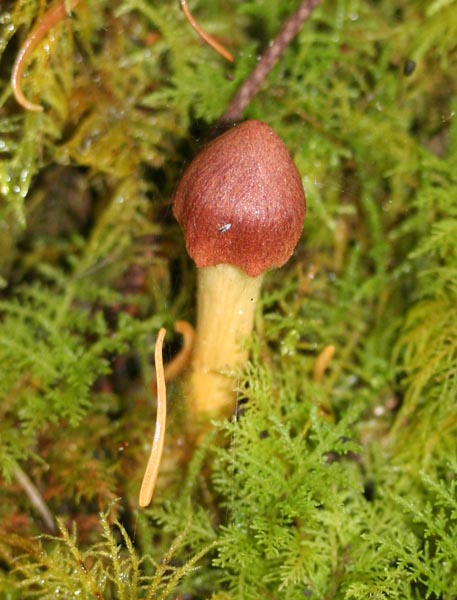
A couple of Entoloma sp. (identification still under way):
Entoloma sp.
Entoloma sp.
There are hundreds of Entoloma species, and separation usually involves microscopic analysis. They are readily recognisable due to their radially-striped caps and finely-constructed gills, which are often lined with the cap colour:

Entoloma sp. gill edges

Their spore print is pink and the spores have a very unusual and distinctive shape:

Entoloma spores at x 400

The Amethyst Deceiver must be one of our most recognisable fungi: 

Amethyst Deceiver

The name 'Amethyst Deceiver' comes from the closely-related Deceiver, which varies so much in colour that it closely resembles many other fungi. No such problem with the Amethyst version.

This Cortinarius has been giving me a bit of bother. I think it might be Cortinarius semisanguineus. Identification awaiting confirmation.


Cortinarius ?semisanguineus
Here's a shot of a young specimen:

Cortinarius ?semisanguineus

Tiny Marasmius rotula specimens were dotted all over dead twigs, looking like little gems in the darkness:

Marasmius rotula

The coral-like Ramaria stricta forms large specimens grouped together to cover large areas of ground under Beech and Spruce:

Ramaria stricta


Whilst walking along the beach, I spotted this excellent shot of the patterns of sand left by the tide. The light was dropping, making this shot look monochrome, but it's in full colour.
Sand patterns on the beach
The pattern reminded me of the Entoloma gills shown earlier in the page, and both will probably be gone by tomorrow, never to return.

Announcement

I'm taking this opportunity to announce the launch of my new food-related blog over on www.donegal-dinner.blogspot.com. If you like food and cooking, then you might find a visit worthwhile.

Sunday, 25 September 2011

High heath

It was surprisingly warm in the hours preceding the predicted storm, so quite a few insects had taken the opportunity to fill up on nectar.


This tiny solitary bee was nectaring alongside an even smaller Empid fly on Common Catsear:
Solitary bee and Empid on Common Catsear


Notice the very thin and upturned ovipositor on this tiny Ichneumonid on Marsh Ragwort:

Ichneumonid on Marsh Ragwort

Quite a few insects are reaching the end of their season and will either die soon or hibernate. This is the hoverfly Helophilus pendulus which has been quite scarce here this year:
Helophilus pendulus on Devilsbit Scabious

And there are still a few Common Carder Bumblebees around:
Bombus pascuorum on Devilsbit Scabious

I've seen a few Small Tortoiseshell butterflies flying around the garden this week. This one nectared on Knapweed for a while and then posed perfectly for its portrait:
Small Tortoiseshell butterfly
Small Tortoiseshells hibernate in sheltered places and then wake in March or April to start off next year's generation.

This is a first for me:
The Stonefly Leuctra fusca
It's Leuctra fusca, a member of the Stonefly family and is known as a Needle Fly for fairly obvious reasons. The nymphs are fully aquatic, but I found this adult hiding on the underside of a Willow leaf which I was examining for the orange fungal rust. The nearest running water is a stream about 50 m. away.

I always check the front lights for moths at night, and I spotted this Lesser Crane Fly. Those legs look almost ridiculously long.
Lesser Cranefly attracted to light

The proposed fungal foray to Ards in about 2 hours' time hasn't quite been called off yet. But it's going to be close.....

Friday, 23 September 2011

Fungal season

Fungi are popping up everywhere, so it's time to get the microscope dusted down, ready for the new season.

The mushrooms that we see are the visible fruit-bodies of the actual fungus, which is usually underground or buried deep inside some substrate, such as wood. The fungus itself will stay in the same place as long as its partner or food source continues to be available: that explains why a particular mushroom can continue to be found in exactly the same location year after year. I'm now beginning to expect my usual crop of Phaeolepiota aurea on the same spot on my lawn at the same time every year. This is a rather scarce mushroom, which is thought to be a nettle associate:

Phaeolepiota aurea
At the beginning, the underside is completely sealed, providing a secure environment for the spores to develop:
Phaeolepiota aurea

Later on, the seal drops to form a ring and the millions of spores are released to be carried by the wind.

Recent studies on Phaeolepiota aurea have confirmed that compounds of cyanide remain in the mushroom, even after cooking, so it has been added to the list of 'poisonous' fungi.

I have previously written about the structure of lichens: fungi which have captured algae in order to utilise the energy that the algae can generate from sunlight. Essentially, lichens cannot survive alone: they need their algal partners to supplement their food supplies. What is particularly interesting, however, is that some fungi can be part-time lichens: most of the time, they survive on their own food resources, but they can capture algae on a temporary basis in order to survive transient periods of hardship. A number of fungi can do this, but it is the Omphalina family which is best known for it.  Omphalinas are small, delicate, trumpet-shaped fungi that are associated with mosses. This specimen is about 8mm. across the cap:

Omphalina griseopallida

I know of a few Omphalina species in my area (we have lots of mossy locations), but this one is new, and looks most like Omphalina griseopallida. I'm taking a spore print to see if that helps with the identification.

Spore prints are one of the basic tools in identification of fungi, and the spores of some species give very strong clues about an identification. This is the spore print of a new species to me: Stropharia aurantiaca.

Spores of Stropharia aurantiaca at x400

Stropharia aurantiaca is a relatively recently-named (1930's) fungus which appears in bark and sawdust that has been used as a top-surface mulch on flowerbeds. In this case it's in a local supermarket car park It has been found numerous times in Northern Ireland, but I can't find any previous records from Ireland.

I'll try to get an in-situ shot later today.

Monday, 19 September 2011

Post hurricane post

The weather continues to be hateful, but I'm guessing that everyone has been in much the same position.

I went up to the boggy area which has many specimens of the late nectar source, Devilsbit Scabious, and found this specimen of the hoverfly Sericomyia silentis. For those of you who know the size of the flowerhead, it will be apparent just how large this hoverfly is.

Sericomyia silentis on Devilsbit Scabious
Devilsbit is a plant that loves damp, acidic soil, in complete contrast with its close relative, Field Scabious, which needs alkaline soil. Interestingly enough, I sometimes find an occasional specimen of Devilsbit Scabious which has the same colouring as the lime lover:

Pink form of Devilsbit Scabious

It's still 100% Devilsbit, though.

Staying with Devilsbit, I found a few rather interesting specimens that were making an extra flowerhead from an existing one:

Devilsbit Scabious with 'extra' flowerheads

Notice the second 'offshot' appearing to the lower left of the central flower. This phenomenon wasn't restricted to one area of the bog: I found multiple specimens spread over perhaps 200 m.

Some specimens of Angelica have survived the storms: these are mostly ones in very sheltered locations. Specimens out in the open have all snapped at ground level. This flowerhead had a number of Ichneumonids still nectaring on it. There are 3 in this shot:


Actually, I just spotted a fourth, right at the bottom of the shot.

This area has quite a few Scots Pines, and I found a few specimens of Suillus flavidus and its bigger brother Slippery Jack, which are always found in association with Pine. I also found the usual swarm of Hebeloma mesophaeum all the way along the edge of the access road:

Hebeloma mesophaeum 
The mosses are Pleurozium schreberi (red veins) and Rhytidiadelphus squarrosus (green 'stars' at 4, 6 and 8 o'clock).

I recently showed a specimen of the leafhopper Cixius nervosus, but I thought this one showed off those wonderful wing veins at their best.

Leafhopper Cixius nervosus
Leaf hoppers - like so many other true bugs - are quite difficult to separate, but the main identification features are visible in this shot.

1) There are 3 'keels' on the thorax.
2) The black dots on the wing edges are larger than those on the inside veins of the wing
3) There is a rather distinct black bar across the front third of the wings.
4) The area between the eyes and the thorax is brownish-yellow.

Let's hope next week's fungal foray isn't rained off.


Monday, 5 September 2011

New Science

Salmonberry - Rubus spectabilis - is a highly invasive member of the Bramble family - originating in western North America - that was originally brought into Northern Ireland as cover for game birds. I saw my first specimens about 5 years ago in a couple of places, but now it's appearing almost anywhere I look in higher locations. The flower is a bright purple, and the berry is a salmon-pink colour (and is incredibly bitter, as I found out to my cost).

I examined a few plants recently and found a couple of leaf-miners:

'Agromyza ideana' on Salmonberry


'Stigmella aurella' on Salmonberry

The first specimen looks very much like Agromyza ideana, which is usually found on Raspberry, and the second looks like Stigmella aurella, which is found on Bramble. The current literature for miners in Ireland and Britain doesn't contain any records of these miners on Salmonberry, so these relationships are both new to science. (The European literature also has no entries for Stigmella aurella on Salmonberry, so that would likely be new to European science). Both mines are well-developed, indicating that these species will be successful in this new host. I'll have to write this up for the appropriate journals once the identifications have been confirmed by the appropriate experts.

Staying with mines, I checked a stand of Bracken where I had previously found my only specimen of the leafmining fly Chirosia histricina and I found it once again:

Chirosia histricina on Bracken

Underside of Chirosia histricina
Given the amount of Bracken that doesn't have this miner, it seems to have very specific microclimate requirements. The literature says 'shady places', and this is under Ash on a north-facing bank, which would certainly qualify as a shady location.

I was actually on a fungus hunt, but I didn't find much of interest in that respect. I did, however, spot a few specimens of the excellent bumblebee-mimicking hoverfly Arctophila superbiens:

Bumblebee-mimicking hoverfly Arctophila superbiens

I had only ever seen this species once before, in a location some 40 km away, so I was delighted to find it on my local patch. Identification is mainly from the very dark wing shade, the all-black legs and the orange hair on the thorax, whilst the abdominal hair is grey.

I coincidentally spotted the bumblebee which the hoverfly is mimicking - Bombus pascuorum - which is still around, but in decreasing numbers as autumn creeps in:

Bombus pascuorum on Devilsbit Scabious
The mimicry is very well-developed here, right down to the grey patches at the base of the wings.

I also liked this shot of the female Cranefly, showing those incredibly long legs:

Female Cranefly

Eyebright is showing all along the centre of paths now:
Eyebright

Eyebright is broken down into a number of species/subspecies. I'm sticking with Eyebright.

A couple of moths came to light on the one night we've had without rain:

Lesser Yellow Underwing

I caught this one at just the right angle to reflect the flash in its eye:
Flounced Rustic