Showing posts with label Bush Vetch. Show all posts

Tuesday, 24 June 2014

New camera and other stuffs

So I bought myself a Canon 70D. The EOS 350 had served me well for nearly 10 years, so it was certainly time for an upgrade.

The 70D has far too many features to discuss here, but it has a few that I am already finding indispensable. Firstly, it has a revolutionary new focussing system, which enables it to more or less instantly decide which direction (nearer or further) to go when focussing. The 350 was fast, but the 70D is near-instant, which is crucial when photographing insects. A fully-articulated rear screen enables me to take shots above my head or down at ground level. 20 megapixels means I don't have to get so close, so depth of field can be better. It can operate over wi-fi, so uploading images means less wear and tear on memory card transfers from camera to computer and back again. Video mode means I can tag images with a piece of voice annotation.

Here are a few shots:

This is the 10mm. micromoth Celypha lacunana, which is out in very large numbers on my local hedgerow:


The micromoth Celypha lacunana


 And this is the strange-looking hoverfly Xylota segnis:

The hoverfly Xylota segnis
The first time I saw it running quickly over leaves, I thought it was a wasp of some kind with those long, grasshopper-like rear legs.

Formica fusca is the ant which is most numerous in my heathy area, and they can often be seen climbing Willow bushes to 'milk' their aphids. This one was behaving very strangely, cropping the fine hairs from a Bramble leaf. I have absolutely no idea why it was doing that.
Formica fusca, an ant
Orchids started flowering last week, so now is the time to see them at their best.
Common Spotted Orchid, with a touch of Heath Spotted

'Cleaner' Common Spotted Orchid

I also took a record shot of the white version of Bush Vetch, which is still slowly expanding its range along a ditch:

White variant of Bush Vetch

 It's still early days for the camera, but I think the results are shaping up well for the future.

Thursday, 20 June 2013

Mixed weather

We're having sunny spells, showers and heavy rain in waves these days. Still, it beats the perma-rain of the last two years.

I really liked this shot of the 7-spot Ladybird. These are voracious predators of aphids, and if you look closely under the left-hand side of the leaf, you can see the antennae of its dinner.


"It's behind you"
This young Rabbit has taken up residence in the ancient Hawthorn hedge at the bottom of my garden: it seems to like being near the hens. I'm happy with all of that, but I'm rather keen that it doesn't find my vegetable plot, which is perhaps another 10m on the other side of the coop.
Young Rabbit
New to my Species Index.

Most beetles have wings which are folded away under the two elytra, which themselves are actually modified wings. The wings can be inflated at incredible speed, and you have to be very quick to catch the unfolding process taking place. I watched this Click Beetle flying from plant to plant and managed to anticipate the moment of launch:


Click Beetle preparing to fly

Leucozona lucorum is a hoverfly that is around in great numbers at the moment. They are very flighty (and will be until the mating season is over), so shots have to be taken very quickly:

The hoverfly Leucozona lucorum

Orange Tip butterflies were very late this year - at least 4 weeks and maybe 6 weeks later than I would expect. Their season is timed to match their foodplant (Cardamine pratensis in this area), and once the eggs have been laid, the adults fade away over the next week or two and won't be seen until May next year, when the next generation hatches.
Male Orange Tip butterfly
Fortunately, I have found a few larvae feeding on the seedpods:
Orange Tip larva on Cardamine seedpods

This is a strange visitor to our area. Salad Burnet - Sanguisorba minor - is a lime-loving plant, and we are are on strongly acidic soil. A few years ago, I limed part of my vegetable plot and I think this came in with a salad mix that I sowed around the same time.

Salad Burnet - Sanguisorba minor
New to my Species Index (although I think it's a bit of a cheat).

For a few years, I have been following the fortunes of a patch of pure white Bush Vetch that I found near the high heath. Many sports don't last long, but this patch is increasing in size and seems to have no problems attracting bees to pollinate it.

White version of Bush Vetch
I have read that a few plant species with blue flowers can occasionally throw pure white sports, mainly in the West. I suppose the ultraviolet parts of the flower still work, even though it's purest white to our eyes.


Wednesday, 6 March 2013

The signs are there

We have rain forecast for the next few days, so I took the opportunity to see what signs of spring I could find.

7-Spot Ladybirds hibernate as adults, so in theory they can be seen at any month of the year if the weather is warm enough. But I like to think that the first sighting of the year is a sign of things to come:

7 Spot Ladybird
Many plants are still in their purely vegetative state, but quite a few are making flower buds or new growth. I always consider Barren Strawberry to be the first true flowering plant in each year. True, Celandines will always flower first, but since they can flower any time from November onwards, the Barren Strawberry is my 'first flower' in any given year:

Barren Strawberry flower bud
The plant at top right of that shot is Germander Speedwell which had a very good year last year:

Germander Speedwell

The lowest stem in that shot shows the diagnostic paired lines of hairs that run along the stem.

Bush Vetch is also pushing through the dead fronds of last year's Male Fern:

Bush Vetch
It will be another 4 months before Slender St. John's Wort is in flower, but already the new growth is forming:

Slender St. John's Wort

I cropped this shot of Opposite-leaved Golden Saxifrage to show the rear wall of the ditch covered in liverworts and mosses:
Opposite-leaved Golden Saxifrage with liverworts and mosses
The main liverwort is Conocephalum conicum ('Snakeskin Liverwort') and the tiny moss is Plagiomnium undulatum.

A few years ago, one of the few local areas to have wild Reedmace was excavated to see if it would be suitable for building a house (it isn't!). Most of the Reedmace disappeared, but some has now made a recovery:

Reedmace - Typha latifolia
Typha is the sole host family for many insects, including some moths and hoverflies. I examined quite a few specimens of the Reedmace for any signs of those species, but none were found. I wonder how long it will take for them to return (if they ever do).

No time is ever wasted in nature: the leaves of Lesser Celandine are hardly full-grown and already the fungal rust Puccinia ranunculi has taken hold.

Puccinia ranunculi on Lesser Celandine

Last year there seemed to be a very wide-ranging absence of fresh mines of the micromoth Stigmella aurella from its main foodplant, Bramble, and I certainly found very few.  So it's good to see a good number of fresh mines (fresh mines are white, whereas old mines from previous years are brown) on the host plant this year:
Mines of the micromoth Stigmella aurella
There are 4 mines on that leaf, all of which appear to have grown to full size. I'm always entertained by the way the mines progress without falling out of the edge of the leaf and also how they seem to detect other mines and take avoiding action before they intersect them (or their own!), especially when older.

Monday, 13 June 2011

Heath

This heathy area was under coniferous plantation until about 8 years ago, and the original flora and fauna are now slowly returning as the land reverts. Willows, heathers, rushes and mosses are the early colonisers, and these largely dictate which other species can be found.

Despite the awful month of May - during which it rained every day - most species are still a bit early this year, so I thought it was time to catch some Spotted Orchids before they reached full flower, when they are not nearly as attractive as they are in the early flowering stages.

This area has Spotted Orchids that cover the spectrum between Common Spotted Orchid and Heath Spotted Orchid, although the closely-related Northern Marsh Orchid that I showed last week is only about 1 kilometre away. These orchids all hybridise freely, and back-cross, so there cannot be any 'pure' specimens left. I can safely predict where I will find specimens that look most like Heath Spotted Orchid, and those are generally on the very edge of ditches, or even in lying water. I strongly suspect that the form of these hybrids is tightly governed by the micro-climate that they live in, and happily refer to all of these specimens as ecomorphs of hybrid Spotted Orchids. To that end I have started to give them a 'parentage percentage', which specifies how much of each of the parents I think are present in each specimen.

Here are a couple that I would place firmly in the Common Spotted Orchid camp, because the front lobe of the flower has a strong tooth:

Common Spotted Orchid

Common Spotted Orchid
The next pair have the outer sides of the flower more rounded and frilled, which sees some aspects of Heath Spotted Orchid creeping in. The spike is also often flatter:
Spotted Orchid

Spotted Orchid

I have included the next shot because it shows the rotation of the flower, which forms upside down, and then rotates into its upright position as it opens:
Spotted Orchid
I think that's my new favourite orchid photograph. Absolutely lovely.

The next shot shows an oddity that appeared in this location about 5 or 6 years ago:

White Bush Vetch
It's Bush Vetch, but rather than the normal blue/purple, it's purest white. When I first saw it, I suspected that some chemical dumping had taken place, but it has spread over the years and has jumped to an area that used to have the normal blue type. It's not unknown for blue or purple flowers to have white variants, and I'm told that this is more common in the west. Maybe the dampness has something to do with it.

Another few heath species have made returns. The first is Heath Milkwort, with the flower just opening:

Heath Milkwort


And my favourite Speedwell, Heath Speedwell, which forms tall, elegant spikes:

Heath Speedwell

The next two shots show two very closely-related micromoths, each about 5mm. long, and which are both leaf-miners on grasses. The first is Elachista luticomella:
Elachista luticomella
And the gorgeous Elachista argentella:
Elachista argentella

I spotted these ants attending their aphids on Willow:
Ants farming aphid for honeydew

Ants often 'farm' aphids, taking the exuded honeydew back to their nest, and protecting their aphids from attack by other species.

Tuesday, 19 April 2011

High Speed

With the current warm weather, every minute seems to deliver new insects and flowers.

Butterflies are hatching, and as soon as they emerge they seem to be concentrating on the next generation just as quickly as they can. This shot shows a pair of Green-Veined Whites: male at the top of the picture, female at the bottom:
Pair of Green-Veined White butterfly


At the moment, the male Orange Tips are still patrolling, looking for the females:
Male Orange Tip butterfly

I think the underside of the Orange Tip is quite beautiful (as well as being good camouflage):
Male Orange Tip - underside

Small Tortoiseshells are looking very threadbare now: they overwinter as adults and the wings have lost most of their scales.

Small Tortoiseshell butterfly

I was watching another of the cuckoo Bumblebees  - Bombus bohemicus - and managed to get a clear shot of one of the identification features. Since these bees don't collect pollen for themselves, they have no use for pollen baskets:
Cuckoo Bumblebee - Bombus bohemicus

Solitary bees make their own nests, with the female collecting pollen to feed her own brood. Solitary bees are usually either mining bees (make tunnels in soil) or mason bees (make tunnels in soft stone or mortar). It should come as no surprise that there are bees which are parasitic on solitary bees, and there are a few species of Nomada which are kleptoparasitic on solitary bees - they steal the pollen from the tunnels. This appears to be Nomada leucopthalma, a kleptoparasite of Andrena clarkiella, which is just coming to the end of its season (they collect only willow pollen). So Nomada leucopthalma will be coming to the end of its season, too:

Nomada leucopthalma

A few more flowers opened today:

Bush Vetch:

Bush Vetch
 Common Fumitory:
Common Fumitory
 And everyone is talking about the Blackthorn flowers this year. The show is quite stunning:

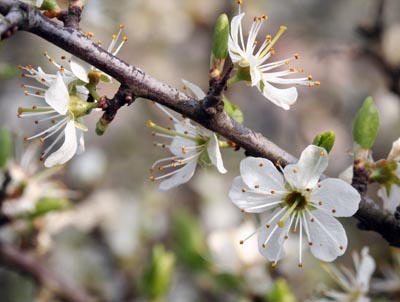
Blackthorn Flowers

April 28th is St. Mark's day, and the Bibio genus of flies appears on or around that date, so they are commonly known as St. Marks Flies. With this being such an early year, they are a couple of weeks earlier than usual:
Male St. Marks Fly
The large black flies that you will currently see flying with their hind legs dangling down is another, larger, species of Bibio.

 Tomorrow I'm off to a limestone area, so I should find something interesting there.

Wednesday, 5 May 2010

Between the showers

The weather has settled into an all too familiar pattern, with rain showers every day. It does mean we have high humidity and clean air, so we have plenty of wildlife that can tolerate consistent showers, but it does mean you have to choose your photography sessions very carefully.

One water-loving species is Water Horsetail - Equisetum fluviatile. Field horsetail is present very close-by, so I'll look out for the hybrid, E x.litorale, which I see from time to time.

(The red stems belong to Meadowsweet which is very prolific in this area.)

The first of this year's Pea family to flower: Bush Vetch - Vicia sepium. This is host to a number of micromoths, and, as expected, the normal purple version is very much earlier than the pure white variant that I've been tracking over the past few years.


This spider caught my eye as it hung on a small piece of web. I must get my eye in for spiders: they're the biggest group that I haven't got to grips with yet. Maybe next year.


Tuesday, 26 May 2009

Gap between the showers

The Chrysomelid beetles are making a fine mess of the Willow leaves, only days after they have fully opened. This is Lochmaea caprea, and is confined to Willow.


Last week I showed Creeping Cinquefoil. This is its very close relative - Tormentil. Amazingly, I still have 3 species from this family to show in the near future.


As soon as the rain stops, the insects are back out cleaning themselves ready for their next flight. This is one of the Tenthredo sp. Sawflies. These are all strictly vegetarian as larvae and many are voracious predators as adults.


The wonderful, minute micromoth Glyphipterix simpliciella is one of the few to have a common name - Cocksfoot Moth. Its larvae live inside the stems of Cocksfoot grass and it is all of 4mm long. Check that on a ruler.


An amazing shot of a dead Holly leaf having been pierced in two places by the shoots of Horsetail, and being hoisted like a banner. The plant to the rear is Meadow Buttercup.


The end of a hoverfly. This spider had caught the fly and was in the process of beginning to wrap it up.


I have an expanding patch of purest white Bush Vetch in just one area. It appears to breed true from seed. I wonder when a sport like this becomes a (sub)species in its own right.