Showing posts with label Empis stercorea. Show all posts

Friday, 3 June 2011

A dry day!

Today was the first dry day since 28th April, so I wasted no time.

The Orange Tip larva continues to graze on the Cardamine seedpods:

Orange Tip larva on Lady's Smock
The micromoth in the next image is the first of two new species for me on today's page. It's Coleophora albicosta, which feeds on Gorse, spinning up inside the flowers and then, eventually, a seedpod.

The micromoth Coleophora albicosta
I like the configuration that Coleophora specimens have....very elegant.

The 6mm micromoth Elachista apicipunctella is a leaf-miner on a number of grasses:

The micromoth Elachista apicipunctella

Moth Flies, or Owl Midges have the most amazing hairy wings. The drag must be immense for such a small (4-5 mm wingspan) creature:

Owl Midge

I thought this close-up of the Banded Snail Cepaea hortensis was worth showing:
Banded Snail Cepaea hortensis

Because of the incessant rain, I missed the very start of the local orchid season. Some specimens of Northern Marsh Orchid already have open flowers:
Northern Marsh Orchid Dactylorhiza purpurella

With all the wet weather we've had, it's no surprise that the fungal rusts are so prominent. Puccinia urticata is specific to Nettle, and can cause these swellings on leaves and stems:
Nettle rust Puccinia urticata 
Fungi are quite expert at manipulating the shape of plants for their own benefit; in this case to maximise the surface area for spore production and dispersal.

Athous haemorroidalis is one of the Click Beetles. Click Beetles have a mechanism (clearly shown in the picture below) whereby they can trap and release a notch on their pronotum with a sudden click and go flying up in the air to right themselves if they get stuck on their back.


Click Beetle Athous haemorroidalis

An identification that has been bothering me for perhaps 8 years has finally been resolved. The Sawfly below is a male Tenthredo livida, which can be distinguished from other Tenthredo species that have white-banded antennae by the two-tone (pale v-shaped) stigma on the wings. You can just make out the red abdomen which identifies it as a male:

Sawfly Tenthredo livida (male)
As larvae, Tenthredo livida eat a wide range of plants, but the most likely candidate in this location is Raspberry. Now that I know what it is, I can check back on Sawfly larvae that I have previously photographed on Raspberry and check them for a match. I like tying up these connections, even if they take 8 years to resolve.

St. Marks Flies continue to appear through the year, and it's now time for Bibio pomacaeus, which is readily identified by the red legs:

St. Mark's fly Bibio pomonae
(The leaf it's resting on belongs to another Northern Marsh Orchid.)

Flies belonging to the Empidae are sometimes known as Dance Flies because they gather in swarms and move up and down in the air as they fly around each other. This is Empis stercorea, which spends its time between dances by catching other insects and sucking out their body fluids with that long proboscis:

Snipe Fly Empis stercorea

Agromyza nana mines Red Clover leaves, and the single larva can be seen right in the centre of the leaf.
Leaf miner Agromyza nana on Red Clover
I think I have a new favourite picture, but I rather suspect I'll get a new favourite, soon.

Sunday, 20 June 2010

Summer mix

The Dog Rose on my hedge has opened, making a large patch of dusky pink. Roses attract all kinds of wildlife from aphids and beetles to micromoths and butterflies, and this picture shows the presence of two other life forms:


The two aphids to the lower left are 'mummified', which tells us that minute (2.5 mm.) parasitic wasps are present. These lay a single egg inside each aphid which then slowly hardens until it forms a protective shell around the developing wasp larva:


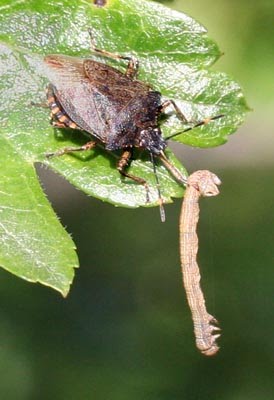
More parasitic behaviour can be seen in this shot of the shieldbug Troilus luridus consuming a moth caterpillar that it has caught:

Troilus luridus is scarce enough, and the only two specimens I have found were three years apart and on the same Hawthorn tree.

Still more predatory behaviour is shown by the structure of the proboscis of this Empis stercorea Dance Fly, which is used to suck nourishment from captured prey:


Spotted Orchids (Dactylorhiza sp. - I'm now refusing to identify these to species until someone admits they've got it wrong and says they're just variants of one or two species) have started to flower, and I think these earliest stages of development are the most attractive:

This one is paired with Common Sedge - Carex nigra:
This paper from 2004 puts it very nicely, allocating the various 'species' of Dactylorhiza into related 'groups'. Clearly much work has yet to be done in this area.

Moths continue to come to light. This is one of the few 'Minors' that can be satisfactorily identified without dissection: Middle-barred minor - Oligia fasciuncula - which is recognised by the dark 'box' with a thin white front border and a wider white rear border in the middle of the wing:

And two micromoths. Firstly Catoptria margaritella, which is thought to feed on mosses and then Cotton Grass:


And a rather worn specimen of Chrysoteuchia culmella, a grass feeder:


Friday, 12 June 2009

Mixed bag

This is the fourth (and final, I think) of the Damselfly species on my local patch. Emerald Damselfly - Lestes sponsa, a male.


The Downlooker Fly - Rhagio scolopacea - is one of the Snipe Flies. They adopt this characteristic position on leaves, bark or plant stems, leaping to catch passing insects and returning to their perch to consume their prey.


I rather suspect that micromoths are widely overlooked. Most of the 'flies' or 'midges' seen fluttering around on verges and hedges are, in fact, micromoths. They can be detected in flight by their erratic, sometimes spiraling, trajectory. The instant they land they become virtually invisible, either blending into the background or hiding under leaves. Most of the shots I get of them come from observing the flight pattern and keeping them firmly in sight until they land.

This is Ancylis badiana, which has two generations per year:


This large (20mm) Ichneumonid is readily recognisable from the white-tipped antennae and ruby-red abdomen. They land on leaves and very quickly run to the underside in search of caterpillars to parasitise.


The very long proboscis of the dance-fly Empis stercorea has multiple uses. Here it is being used to suck up nectar from Cow Parsley flowers.


Yet another new moth species for me: Coxcomb Prominent - Ptilodon capucina. You can just imagine how well this would be camouflaged against bark or dry leaves.