Showing posts with label Common Fumitory. Show all posts

Monday, 22 April 2013

A bit warmer

We had a couple of weeks when the wind was blowing from the east, and I agree that it's "fit for neither man nor beast". I reckon nothing happened in wildlife terms during that period, so I'd say we are currently running about 4 weeks behind what I have come to expect on the patch. Now that we have reverted to the prevailing westerlies, we have to dodge the rain showers. Ho hum.

Now that Willow catkins have opened, a few insects have started to pollinate. This hoverfly is Parasyrphus punctulatus:

The hoverfly Parasyrphus punctulatus
Parasyrphus punctulatus is one of the earliest hoverflies to be found, although I rarely find it in large numbers. The main identification features are the semicircular yellow markings on the abdomen, which are strangely described in the standard reference as 'hemispherical'.

I have seen plenty of queen bumblebees searching for a place to nest - both Bombus terrestris and Bombus lucorum - seemingly in larger numbers than I have seen before. Perhaps the searching season has been compressed by the weather. I first found Bombus pratorum - the Early Nesting Bumblebee - in a fairly wild area in 2006, but I have seen several workers appearing on the hedgerow in the last few years: apparently it is becoming increasing urbanised due to the removal or loss of its usual habitat.

I found this queen - one of two queens that I have seen for the first time this year - crawling slowly around, so I suspect she had just emerged, since she is shiny clean.

Queen Bombus pratorum
Bombus pratorum is one of our smaller bumblebees, with queens the size of the workers of larger species and workers not much larger than a pea. Identification of the queen is based on size, the orange/red tail and the two-tone yellow bands on thorax and abdomen. You can see the worker here, and the male here.

A couple of moths came to light. The micros were worn beyond identification, but the March Moth is always very easy to identify due to the very triangular shape of the wings at rest:

March Moth
This is a good 6 weeks later than I normally see.

A few more flowers have opened, the most notable being Common Fumitory:

Common Fumitory
The Fumitory family (which is large and complex) gets its name from the glaucus ('smoky') colour of the leaves.

The 1k square challenge list now sits at 295 species. The list can be seen here.

Sunday, 15 April 2012

Sun's back

After a couple of weeks of rain, sleet and hail, things have warmed up again. Various Solitary Bees have been nectaring, and I spotted my favourite bee - Andrena cineraria - as she gathered pollen from a Dandelion:

The solitary bee Andrena cineraria
I always think they look like they're wearing Barbarians rugby jerseys. Here's a side shot:

Andrena cineraria
Andrenas (and other families of Solitary Bees) lay eggs in their own nesting tunnels, and although they might form communal 'villages' of individual nests, the female feeds only her own larvae with pollen. Nomada sp. Cuckoo Bees are ever present near the nests, hoping to get an opportunity to nip in and steal the pollen store when the female is out foraging.

Bilberry (locally called Mulberry) has flowered:

Bilberry flowers
Bilberry is a vital food source for a number of insects, most notably the Green Hairstreak butterfly. I like the way the unopened flower can sometimes contain water droplets:

Unopened Bilberry flowers
I have a number of different species of Fumitory on my patch. This is Common Fumitory, which gets its name from the grey-green foliage which can look a little smoky:

Common Fumitory

The local Willows are all in full leaf now, so it's time for the various Willow Leaf Beetles (Chrysomelids) to appear. This is Lochmaea caprea, which I happened to spot as it sunbathed on my recycling bin (which happens to be right under a Willow):

Willow Leaf Beetle - Lochmaea caprea

The Willow leaves will soon be showing the attentions of the beetle larvae as they eat off the top surface of the leaves.


I also spotted a few Bibio sp. (St. Marks Flies), which usually emerge around St. Mark's day (April 25th), so we're still running slightly ahead of schedule this year despite the last two cold weeks.

Tuesday, 19 April 2011

High Speed

With the current warm weather, every minute seems to deliver new insects and flowers.

Butterflies are hatching, and as soon as they emerge they seem to be concentrating on the next generation just as quickly as they can. This shot shows a pair of Green-Veined Whites: male at the top of the picture, female at the bottom:
Pair of Green-Veined White butterfly


At the moment, the male Orange Tips are still patrolling, looking for the females:
Male Orange Tip butterfly

I think the underside of the Orange Tip is quite beautiful (as well as being good camouflage):
Male Orange Tip - underside

Small Tortoiseshells are looking very threadbare now: they overwinter as adults and the wings have lost most of their scales.

Small Tortoiseshell butterfly

I was watching another of the cuckoo Bumblebees  - Bombus bohemicus - and managed to get a clear shot of one of the identification features. Since these bees don't collect pollen for themselves, they have no use for pollen baskets:
Cuckoo Bumblebee - Bombus bohemicus

Solitary bees make their own nests, with the female collecting pollen to feed her own brood. Solitary bees are usually either mining bees (make tunnels in soil) or mason bees (make tunnels in soft stone or mortar). It should come as no surprise that there are bees which are parasitic on solitary bees, and there are a few species of Nomada which are kleptoparasitic on solitary bees - they steal the pollen from the tunnels. This appears to be Nomada leucopthalma, a kleptoparasite of Andrena clarkiella, which is just coming to the end of its season (they collect only willow pollen). So Nomada leucopthalma will be coming to the end of its season, too:

Nomada leucopthalma

A few more flowers opened today:

Bush Vetch:

Bush Vetch
 Common Fumitory:
Common Fumitory
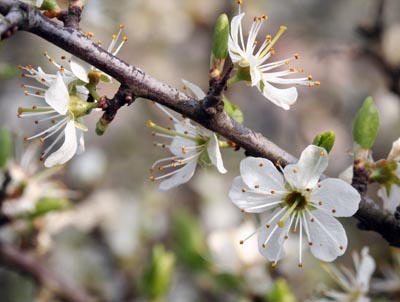
 And everyone is talking about the Blackthorn flowers this year. The show is quite stunning:

Blackthorn Flowers

April 28th is St. Mark's day, and the Bibio genus of flies appears on or around that date, so they are commonly known as St. Marks Flies. With this being such an early year, they are a couple of weeks earlier than usual:
Male St. Marks Fly
The large black flies that you will currently see flying with their hind legs dangling down is another, larger, species of Bibio.

 Tomorrow I'm off to a limestone area, so I should find something interesting there.

Monday, 4 October 2010

Still new

A visit to the woodland fringe to see what fungi were around turned up a lot more than just mushrooms:

This large (20 mm.) Pterostichus niger beetle ran quickly across the path. If you've ever tried panning a running beetle using a macro lens, you'll realise just how tricky this shot was:


Common Fumitory is making another push before the season is over:


Caddis Flies very often come to light and many of them are confused with moths. This is one of the Limnephilidae; the larvae make mobile cases from debris at the bottom of still water. Plenty of that around here.....


The leaf-mining fly Pegomya solennis makes mines in Dock leaves. This one is on Sorrel:


This close-up of the larva shows how complete the eating process is: only the top and bottom layers of cells are still in place, leaving a very thin layer that looks like frosted glass. The 'mouth' is to the left, at the interface between leaf and mine:


I did find a few fungi, including the always-bizarre Helvella crispa:


And a fine specimen of the large (15 cm. tall) puffball Handkea excipuliformis:


Liverworts are some of our most primitive plants: they're often found on the back walls of ditches or on woodland paths. This is a new one for me and I'm tentatively calling it Blasia pusilla, although that might change after consultation:
Size of the section shown? About 6 mm.

Sunday, 11 April 2010

Hot Spot

I went to a spot that's usually very good at this time of year (south-west facing vertical banking below a hawthorn hedge) . It proved to be a good choice.

As soon as I saw this little (12mm) hoverfly, I knew she was new to me. She appears to be a female Melangyna, and a couple of microscopic features suggest Melangyna lasiopthalma. Since this would be a first Irish record, I need to go back and get some more solid evidence.


This Small Tortoiseshell was basking and feeding on the Lesser Celandines. It seems in pretty good condition, considering it has overwintered in those freezing conditions:


Common Fumitory - Fumaria officinalis - adds a splash of pink to the predominantly yellow verge:


A couple of weeks ago, I mentioned the tight threads that pull the Coltsfoot head into a downward-facing position. Here's a shot that shows the process:

Primroses were visible in a more sheltered part of the bank:


The queen bumblebees are getting very heavy already, and this B. cryptarum was clumsily crashing from flower to flower. Some appeared unable to fly at all and simply crawled from one flower to the next. I presume her nest is within walking distance!

The fungal rusts don't waste any time. The leaves are quite fresh and already the yellow spots of Uromyces dactylidis are clearly visible on Celandine leaves:


Yet another new member of the Orthosia family, the Clouded Drab - Orthosia incerta - came to light last night. Guess which pollen it eats....