Showing posts with label Carex nigra. Show all posts

Saturday, 14 August 2010

Plan C

En-route to my chosen photography spot (plan A) for today we got stuck behind a slow-moving tractor, so I chose an alternative location. When we arrived there our usual parking spot (plan B) was occupied, so we moved on to location 3 (plan C). It seemed that we were destined to find something special, and so it turned out: two new species for me, one of them a first county record.

Psychoides filicivora is a micromoth that eats the spore-bearing sori of ferns, primarily Male Fern. The larva gathers the contents of the sori and constructs a shelter from them. The shelter is the brown spore mass to the left of the midrib below. You can see where the sori have been removed from the frond to the right of the midrib:
Psychoides filicivora was first discovered in Ireland in 1909 and has moved to western Wales and England, mostly in coastal areas.

My second new discovery was the macromoth Haworth's Minor, which is usually found on Ragwort if the moth is out before dark. This is a very local species which feeds on Cotton Grass as a larva. As it happens, the nearest Cotton Grass is close to plan B where we normally park the car, perhaps 500 m. away.


I also got a rather nice shot of this Ichneumonid just as it landed. Notice the black stigma on the wing, which is a rather good diagnostic for Ichneumonids.

Sneezewort is also very local: I only ever see it in a couple of very small patches:
Finally, we can see that autumn is rolling in. These are the seeds of Common Sedge:

Sunday, 20 June 2010

Summer mix

The Dog Rose on my hedge has opened, making a large patch of dusky pink. Roses attract all kinds of wildlife from aphids and beetles to micromoths and butterflies, and this picture shows the presence of two other life forms:


The two aphids to the lower left are 'mummified', which tells us that minute (2.5 mm.) parasitic wasps are present. These lay a single egg inside each aphid which then slowly hardens until it forms a protective shell around the developing wasp larva:


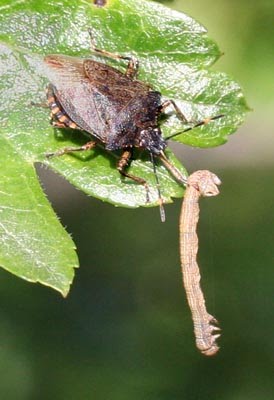
More parasitic behaviour can be seen in this shot of the shieldbug Troilus luridus consuming a moth caterpillar that it has caught:

Troilus luridus is scarce enough, and the only two specimens I have found were three years apart and on the same Hawthorn tree.

Still more predatory behaviour is shown by the structure of the proboscis of this Empis stercorea Dance Fly, which is used to suck nourishment from captured prey:


Spotted Orchids (Dactylorhiza sp. - I'm now refusing to identify these to species until someone admits they've got it wrong and says they're just variants of one or two species) have started to flower, and I think these earliest stages of development are the most attractive:

This one is paired with Common Sedge - Carex nigra:
This paper from 2004 puts it very nicely, allocating the various 'species' of Dactylorhiza into related 'groups'. Clearly much work has yet to be done in this area.

Moths continue to come to light. This is one of the few 'Minors' that can be satisfactorily identified without dissection: Middle-barred minor - Oligia fasciuncula - which is recognised by the dark 'box' with a thin white front border and a wider white rear border in the middle of the wing:

And two micromoths. Firstly Catoptria margaritella, which is thought to feed on mosses and then Cotton Grass:


And a rather worn specimen of Chrysoteuchia culmella, a grass feeder: