Showing posts with label Sicus ferrugineus. Show all posts

Tuesday, 23 August 2011

What's that yellow thing in the sky?

Sun! We had almost four hours of continuous sun today, so I made a bee-line for the Angelica.

I took around 200 shots of whatever looked good, and these are the highlights:

The Peacock is a butterfly that I see quite rarely. I'm not sure if there were a few of them on this woodland ride today, or if the same one was flying along overtaking me from time to time. The Peacock is a nettle feeder and the late summer generation is emerging now. These will overwinter as adults, emerging in spring as soon as it's warm enough:
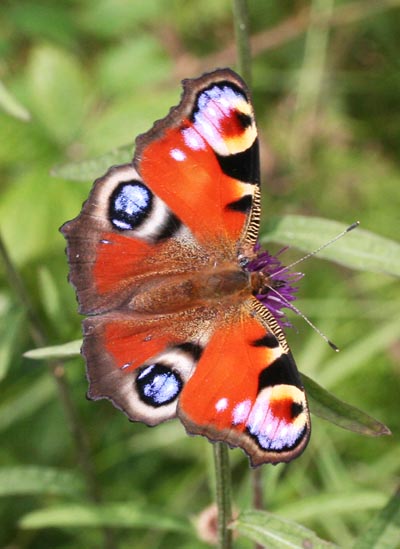
Peacock butterfly

Sicus ferrugineus is a conopid fly that can often be found crouched on knapweed flowerheads waiting for a bumblebee to land:

The Conopid fly Sicus ferrugineus
These are parasitic on worker bumblebees, but although I saw a good number of Bombus pascuorum workers today, none of them landed near the fly.

Leucozona glaucia is one of the most colourful hoverflies that we have. The combination of blue abdomen, yellow scutellum and shiny brown thorax is quite striking.

The hoverfly Leucozona glaucia
I caught a few glimpses of its duller relative, Leucozona laternaria, which I hope to show soon.

Sawfly larvae can be distinguished from moth and butterfly larvae by counting the number of prolegs. But I can generally pick them out quite quickly by their very round-shouldered appearance:

Sawfly larva on Ribwort Plantain
This close-up shows the semi-translucent nature of the body:
Close-up of sawfly larva
I went through the checklist of sawfly larvae and their host plants, but the only one specific to Ribwort Plantain doesn't match. That probably makes it a generalist polyphage, so the only way to find out what species it is would be to breed it through and identify the adult.

Caddis Flies are often mistaken for moths, especially when they come to light at night. The main distinguishing feature is the forward-facing antennae (although some of the longhorn moths also have this feature, in which case the Caddis Flies are recognised by their almost parallel antennae). This specimen is a female, identified by the greater number of jointed segments (5) in her mouthparts:

Caddisfly, member of the Limnephilidae family
That's the first Caddis that I've seen nectaring.

Caddis larvae are aquatic, living inside a case made from stones, shells, twigs or leaves, so the adults are usually seen close to water.

The Great Diving Beetle is also aquatic, and I found this one lying dead near a dried-out puddle:

Great Diving Beetle

The Angelica is already running to seed, so I suppose I might have another two weeks of it left. It's certainly a major source of nectar for insects, and I found hundreds of hoverflies, dungflies, sawflies and other assorted insects nectaring on it today. This ichneumonid caught my eye, due to its very long ovipositor:

Ichneumonid on Angelica


Monday, 20 July 2009

Playing catch up

In the normal order of things, higher order species tend to prey on lower-order species, so wasps and bees tend to be predators on flies (or members of their own order). The Conopid fly Sicus ferrugineus, however, reverses this trend. These are parasitic on bumblebees, stapling a single egg into the soft underside of the worker's abdomen. This oviposition is said to take place in flight, but I have never seen it happening. Once the bumblebee has been parasitised it tends to change its feeding habits, presumably to the benefit of the fly larva.


Mesembrina meridiana is easily recognisable due to the orange wing base. The name indicates that it is a noon flyer, and that's when I usually see them.


Angelica has flowered and that means plenty of shots of nectaring insects. this is the Tree Wasp - Dolichovespula sylvestris. It has an overall orange feel to the colouration and the antennae bases are yellow. Facial decoration is a single small spot.


This male hoverfly looked unusual, but it consistently keys out to the very common Eristalis pertinax.


Trombidium sp. mites are usually seen scrambling over the base of plants as they search for rotting vegetation. This one was sunning on a grass blade.


Those of you who have been following my websites for a few years will know that this is one of my favourite flowers: Slender St. John's Wort - Hypericum pulchrum. The latin name shows that I'm not alone in that opinion.


This pristine flower of Meadow Buttercup - Ranunculus acris - caught my attention:


Finally for today - Eyebright. That's as far as the id is going.

Friday, 8 August 2008

Another Bumblebee parasite

Earlier in the year I showed the Cuckoo Bumblebee Bombus bohemicus, which is parasitic on the bumblebee Bombus lucorum s-l, by taking over the nest and using it to raise its own young.

The Conopid fly Sicus ferrugineus is another parasite on bumblees, but this time the behaviour is a bit more personal. It sits in wait beside a convenient flower:


And then leaps out to staple an egg upwards into the soft abdomen of a passing worker bumblebee. Here's a close-up of the fly, showing the upturned abdomen:

Note how the abdomen curves right round - in almost a full circle - until it's pointing upwards.

And this close-up shows the upward-pointing ovipositor.


Recent studies have indicated that a parasitised bumblebee will change its feeding pattern after the egg has been laid. Perhaps this is to make sure the diet suits the fly rather than the bee.

It's tough out there.