Sunday, 10 April 2011

Recolonisation

The area I went to today was Spruce plantation for 50 years, then it was clear-felled about 10 years ago.  The original heath environment has recovered somewhat, leading to a wide diversity of wildlife where there was nothing but a black, arid desert for 50 years.

The area is rich in lichens, mosses and heathers, and the remaining stumps and logs are home to more lichens, fungi and insects.

Bilberry is just flowering now, and this flower has drops of what I presume is nectar forming on the inside:

Bilberry flower
Racomitrium mosses have a very distinctive appearance: each leaf ends in a long, twisted hair that gives the plant an overall pale colouring.

Racomitrium lanuginosum
Peltigera lichens are very leafy in appearance, although their colouring ranges from black to palest grey. This huge (40 cm.) specimen of Rabbit's Paw lichen -Peltigera membranacea - is growing on a dead log. 


Here's a close-up of one or two of the individual 'leaves' (properly called 'thalli'):

Peltigera membranacea
Equisetums (popularly known as Horsetails) are some of our most ancient plants. This immediate area has three species in very close proximity, although I do know of a nearby area with Wood Horsetail which clings onto remnants of its original woodland habitat (which presumably preceded the Spruce plantation).

Marsh Horsetail tends to grow in the fringes of wet areas:

Marsh Horsetail

Whilst Water Horsetail definitely prefers its feet to be very wet:

Water Horsetail

Field Horsetail has separate, pale, fruiting growths, which precede the green non-reproductive shoots:

Field Horsetail

Horsetails reproduce via spores which have hair-like growths attached to them. These hairs are very sensitive to humidity and they expand and contract very rapidly, enabling the spores to move through the undergrowth as if they were walking. 

This next shot is rather interesting:
Bombus bohemicus

It's Bombus bohemicus, one of the parasitic Cuckoo Bumblebees. Bombus bohemicus is parasitic on the white-tailed Bombus lucorum complex and, yet again, timing is critical here. The queen of the host species finds a place for her nest and lays her first batch of worker eggs. The cuckoo bumblebee then invades the nest and kills the original queen before laying her own eggs. The host workers then proceed to feed the cuckoo bees for the rest of the season. I watched this cuckoo bumblebee feeding on nectar and then it proceeded to remove all traces of pollen from its legs (you can see the pollen on the grass in the picture.) Since one of the primary roles that bumblebees perform is pollination, it's clear that adult cuckoo bumblebees are of no benefit to either plants or their hosts.


Another legacy of the original woodland environment is the occasional specimen of Wood Sorrel:
Wood Sorrel
Micromoths are just beginning to make their appearance for the year. This is Grapholita jungiella:

The micromoth Grapholita jungiella
These micros are very active at the moment, and you usually have to be patient enough to follow their very erratic flight in order to see them at rest after they eventually land. 

Tuesday, 5 April 2011

Gap in the rain

Normal service has been resumed after wonderful weather in March, and I have been sitting (no, standing!) glowering at the rain for the last few days. I spotted a short burst of sun, so I rushed off to the most likely spot for a few moments.

The patches of Celandines are all fully open in the middle of the day, so the insects were making the use of the gap in the weather, too. The following shots of hoverflies illustrate some of the difficulties we have in making accurate identifications.

This is a male (eyes meet in the middle) Melanostoma species:

Male Melanostoma mellinum on Celandine
The (relatively) short abdomen leads me to Melanostoma mellinum, because the alternative, which is Melanostoma scalare, has a much longer abdomen in the male.

Notice the very slender front feet.

Next we have a male Platychierus sp. (notice that the front feet are much wider and longer than those of the Melanostoma). The legs also appear to be more robust than those of the Melanostoma.

Male Platychierus sp.
If I was a gambler, I'd say Platychierus albimanus, but I'd like a look at the abdominal stripes before committing.

The next is quite a different beast altogether. It's a female (eyes don't meet in the middle) Cheilosia sp. Cheilosias are darker, chunkier and larger than the two previous families, and although it's difficult to detect from this shot, the wings have a bronze tint to them. Other shots leave me quite convinced that it's Cheilosia albitarsis, and the size is ok for that, too. 

Female Cheilosia sp.

This male Eristalis pertinax was basking on a Buttercup leaf:
Male Eristalis pertinax
Given the absolutely pristine condition (clean feet, shiny wings, clean hair, no pollen), and the fact that the wings look a very little on the small side, I'd say this had just emerged and the wings still have to finish inflating.

And this is also an emerging specimen: the first Common Carder Bumblebee - Bombus pascuorum - of the year. This has to be a queen, although these are much smaller than the queens of the darker bumblebees that we have around here.
Emerging Bombus pascuorum queen
This 7-spot Ladybird was running around leaves and flowerheads looking for aphids. Given the speed of the chase, this was a very difficult shot. No time for basking in this case:
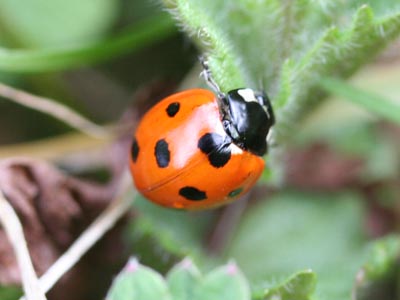
7-spot Ladybird

It's really full speed ahead on all fronts at the moment. This Common Dog Violet - Viola canina - is also just opening: the petals still have to rotate to their final positions.

Viola canina
I've included a side shot to show the pale, notched, spur that identifies this species:


Hartstongue fern is usually the first to unravel. I have 15 or 16 different species of ferns on this stretch, so we should be able to follow the sequence of these as they open up:


Not bad for about 10 -15 minutes.

Monday, 28 March 2011

Lovely weather

Most of the flowering plants are working to the normal schedule: the cold winter appears to have had little or no negative effect. Primroses have opened up all along the verge and ditch edges:

Primrose
The Barren Strawberry can be separated from the wild strawberry by the notch in the outer edge of the petals and also by the slightly glaucus appearance of the leaves:

Cow Parsley is beginning to show faster growth now, and already the fungal rust Puccinia chaerophylli is in evidence.

Puccinia chaerophylli on Cow Parsley

References say May-June, although I have found it in mid-April. I'm beginning to wonder if this is going to be an 'early year'.

Most of the early moths are showing up now:

Early Grey - a Willow pollen feeder

Early Thorn, found on many broad-leaf woody plants

Twin-spotted Quaker - another Willow feeder

Hebrew Character - one of our most widely-spread moths. Eats many plants.

Caddis flies are often mistaken for moths, but the wings are downy rather than scaled and the antennae are held in a forward-pointing position.

This specimen appears to be one of the Anabolea family, but it could be one of 25 different species.


Caddis fly larvae are usually aquatic and live in cases made from debris glued together and rolled into a tube.

Tuesday, 22 March 2011

Keep learning

Over the years, as experience builds up, you make a series of 'rules' which help you reach an identification. Until yesterday, one of my rules was "If you see a bee which is less than 20mm long, then it isn't one of the social bees". Applying this rule, I leaned towards one of the Andrena solitary bees for this specimen: 


But it didn't match any of the images that I could find in the usual places. When I asked for help, back came "It's a Honeybee". Blinded by assumption (and not helped by the fact that this was roughly 60% - 70% as big as I would normally see), I had excluded the obvious. Factor in the fact that Honeybees have become very rare in our area, and the mistake is easy to make.

Assume nothing.

Moving swiftly on......

This Eristalis tenax hoverfly has the very dark colouring that we expect to see in early specimens. The summer generation of many of our hoverflies is much brighter due to the higher temperatures. This female will have mated at the end of last year and has managed to successfully shelter in some nook or cranny through the -17 degrees that we endured in December:

Female Eristalis tenax
The Willow catkins opened last Thursday (17th) and insects have been busy nectaring and gathering pollen ever since. This queen Bombus lucorum bumblebee found the pollen quickly enough:

Queen Bombus lucorum
She is now gathering enough pollen to feed the first few workers from her nest, and she will spend the rest of the year laying more eggs to sustain the nest and produce drones and queens for next year's generation. A few of the new queens actually become workers for a while at the end of the season, gathering pollen alongside the last of the workers.

With the early willow pollen season being so short, no time is wasted before the willow-dependent moths appear. This is the first Common Quaker - Orthosia cerasi - of the year:

Common Quaker - Orthosia cerasi
The Common Quaker is readily identified by the large, rounded, 'kidney mark' which has a pale, thin, outline which matches the colour of the thick band near the trailing edge of the wing. 

Friday, 18 March 2011

Full steam ahead

After a wet early start, St. Patrick's day eventually brightened up and I went to an area that always provides early interest. This is the view looking north into an Ash wood with a stream along the right hand side.

View north into the Ash trees
Lesser Celandine is out all along the edge of the stream:

Lesser Celandine with Creeping Buttercup leaves to the right
No time is wasted before the fungal rusts appear. This is Uromyces dactylidis, which is common on leaves of various Ranunculus species, especially Lesser Celandine:

The fungal rust Uromyces dactylidis on Lesser Celandine 
And Puccinia lapsanae, which grows exclusively on Nipplewort. Notice that the rust has forced the leaf to grow a 'bulge', which serves to increase the available area for spore production/dispersal of the Puccinia:

Puccinia lapsanae on Nipplewort leaf

The ditch is also home for Opposite-leaved Golden Saxifrage, which has to be one of the most symmetrical plants I know:
Opposite-leaved Golden Saxifrage in flower
My last post showed an old mine of the micromoth Stigmella aurella on bramble. This leaf has at least 6 mines, some of which are currently occupied:

At least 6 mines of the micromoth Stigmella aurella on Bramble

This shot shows one of the micromoth larvae actively mining from left to right. Notice that the mine has abruptly turned right just before the margin: there must be something that the larva can detect that makes it turn before it is in danger of falling out of the leaf.
Larva of the micromoth Stigmella aurella
That shot is taken from below the leaf looking upwards, and shows light shining through the upper surface of the leaf, through the larva and through the lower surface of the leaf. Given that the leaf is no more than a millimetre thick, the larva is probably around 500 microns thick (and 3 millimetres long).

The ditch wall has many mosses and liverworts; these capsules belong to the moss Bryum capillare. Last year's capsules are still present, and the leaves of the Bryum can be seen to the bottom right of the image.

Capsules of Bryum capillare

Lastly for today, flowers of Hairy Bittercress, also known as Jumping Cress. If you want to discover the origin of the second name, just touch some ripe seedpods.
Hairy Bittercress (also known as Jumping Cress)

Monday, 14 March 2011

Green shoots of recovery

We've been having some very variable weather for the last couple of weeks, with about 15 cm. of snow at the weekend. The heat last week certainly stimulated some growth on the Raspberry canes:

First Raspberry leaves
I was a bit surprised to see a single flower of Germander Speedwell which has clearly suffered from the sharp dip in temperature that came with the snow:

Germander Speedwell
Leaf-miners always intrigue me, and the most common mine in this area is the micromoth Stigmella aurella. I often pause to have a look at the mine and see if I can work out the factors that determine the route of the mine:
Mine of the micromoth Stigmella aurella 
In this instance, the mine has started below right of centre and looped round a spot of rust on the leaf. It then heads for the central vein (which is the part of the leaf that's furthest away from the edge) and follows that vein for about half the length of the leaf. It then deviates outwards towards the edge (it has to do this at least once, since the central vein isn't long enough for a whole mine) and follows the edge without actually reaching the edge (how do they do that?) before turning back into the central vein to complete the mine.

The large fungal spots on either side of the vein are the fungal rust Phragmidium violaceum, which appears in summer and autumn as bright orange dots inside an expanding purple ring on the leaves.

Sunday, 6 March 2011

Elementary, my dear reader

Moth identification is a dark art, and last night a famous quotation from Sherlock Holmes came to mind: "When you have eliminated the impossible, whatever remains, however improbable, must be the truth." 

My version, adapted to Moth identification, is as follows: "In March, when you have eliminated all other possible identifications, then the moth is Clouded Drab, no matter how unlike the specimen is to the usual illustrations."

Clouded Drab - Orthosia incerta

I showed my first Clouded Drab last year in April (Click here to see it), and I'm sure you'll agree there is little superficial similarity between the images. Clouded Drab feeds on many broadleaf plants as a larva.

Another timely moth is the March Moth - Alsophila aescularia, which think is a rather delicate little beast:

March Moth (male)
Yet again, the females of the March Moth are wingless. It seems that there's some correlation between the cold-weather moths and flightless females (although it's not exclusive to them). There must be some advantage  in that system, but I can't quite work it out.

My first Beetle for the year is one of the Chrysomelids, or Leaf Beetles - Chrysolina staphylea. I'm seeing more of these each year since I first recorded it 3 years ago.

The Chrysomelid beetle Chrysolina staphylea

It's about the same size as a 7-spot Ladybird, and they can often be found in the same locations.