Monday, 7 June 2010

Accelerating towards the solstice

99.9% of the bumblebees seen any year will be female; either queens or workers. The much rarer males or drones are generally brighter, with much wider yellow bands and a yellow tuft of hairs on the head. This is a male Bombus lucorum (or more probably Bombus cryptarum, which seems to be my local form of the Bombus lucorum complex):


Crab Spiders don't make webs, but instead lurk on leaves and stems of plants, poised to leap out on unsuspecting prey. This Xysticus cristatus wasn't particularly well camouflaged (which is probably why I saw it so readily):


Small Copper butterflies are always scarce. Since they feed on Sorrel - which is very common -there must be some other environmental factor which governs their development.


The Tenthredo sp. sawflies are just starting to make an appearance. Aggressive predators as adults (although vegetarians as larvae), they will have a field day on the larger umbellifers when they start to flower next month.


More moths continue to come to light. This is a new species for me: the Map-winged Swift - Hepialus fusconebulosa.


And this is the Beautiful Golden Y - Autographa pulchrina:


This last shot isn't so much about the aphid and her young, it's more about the amazing look of the leaf of Cocksfoot grass:

Friday, 4 June 2010

Disused quarry

Disused quarries often flood after a while, and our local one is often good for damselflies and dragonflies. It was a bit windy today, and although I saw some Blue-tailed damsels, I couldn't get a picture.

The quarry has its own micro-climate, and is home to a few species that I don't find anywhere else on my patch.

This Mayfly is one of the Baetidae, probably from the Cloeon or Procloeon families, which prefer still water to running water:


Mouse-ear Hawkweed - Pilosella officinarum - is usually associated with limestone, which is where I normally see it, but the quarry's upper levels are covered with them:


Ox-eye daisy is fairly widespread, but it's always earlier where the sun heats up the rock:

Male specimens of the micromoth Cydia ulicetania can be seen flying over Gorse (the host plant) during daylight:
The females are more nocturnal.

Thursday, 3 June 2010

Dynamic habitat

Our highest local point was originally deciduous woodland which was felled in the 1950s to make way for a Spruce plantation. The Spruce was clear-felled 5 years ago and replanted with mixed Beech and Larch. One particular spot was excavated for use as a log store for a couple of years and that has now turned into a small pond. So within a very small area we have remnants of the original deciduous woodland, decaying Spruce residue and an evolving pond ecology.

The following shots illustrate the confused (and, I think, transient) ecology.

Spotted Orchids are rather common around this area, but this is the only local spot that has Northern March Orchids - Dactylorhiza purpurella.

These freely hybridise with Common Spotted Orchid and Heath Spotted Orchid, and I'll show both of those hybrids in the next few weeks.

A few water plants have appeared at the pond's edge: This is Water Forgetmenot - Myosotis scorpioides:
And this is Brooklime - Veronica beccabunga (what a wonderful name):

While I was watching some Water Crickets - Velia caprai - skating over the pond's surface, a Dungfly accidentally landed on the water. Within about two seconds, the fly was surrounded by perhaps twenty of the Water Crickets that skated up to two metres to get to the surprise meal:

I suppose they must use water vibration to detect the prey.

One species that remains from the deciduous days is Wood Horsetail - Equisetum sylvaticum:


Tuesday, 1 June 2010

Maybe I'm urban now

I first found the Early Nesting Bumblebee - Bombus pratorum - on my patch about 3 years ago. Its usual habitat is in more rural surroundings, but due to agricultural 'development' it is now becoming more urban, although that's hardly how I would describe my area. This little worker is on Raspberry which suits the short tongue very nicely. It's about the size of a pea.


Meadowsweet is showing nicely now and the fungal rust Triphragmium ulmariae is already well in evidence. Notice that the fungus has affected the leaf's growth enough to turn it completely over. This alteration of the plant growth is purely to assist the fungus to spread by spore dispersal, and qualifies the fungus as a plant gall.


Brightly-coloured flies are often Hoverflies, but this little Soldier Fly can be recognised by the wing veins. No identification yet, but that spiked scutellum must be a clue:

Yes, that's my reflection in the thorax.

Monday, 31 May 2010

Sunshine continues

This shot of a male Andrena sp. solitary bee shows the triangle of three extra 'eyes' that lie between the two main eyes. These ocelli are very sensitive to rapid changes in light, and are used to detect movement, whereas the main eyes are slower and are used for navigation and object recognition:


Larger Ichneumonids are now a fairly regular sighting along the hedgerows. They fly slowly under leaves looking for their host caterpillars:


The Snipe Fly Rhagio scolopacea is known as the 'Downlooker' due to its more usual habit of hanging vertically, facing downwards waiting for prey to fly past. This is a male:


Hoverflies are some of our most handsome (and useful! - they pollinate flowers, trees and crops) insects. This is a male Leucozona lucorum:


Sawflies - closely related to wasps and bees - remain shrouded in mystery. They are strictly vegetarian as larvae (indeed some are considered to be crop pests), but largely carnivorous as adults. The larvae closely resemble the caterpillars of moths and butterflies, but many remain unidentified. The existing reference documentation is very old, and I feel that these must be the next area for extensive research and documentation. Note: the ocelli are also visible on this one that I found wandering over Bramble:

Most Sawflies are tied to a particular plant or family of plants, so I'd bet on this one being a Bramble feeder.


A bright blue Chrysomelid beetle, also wandering over Bramble:

The only blue Chrysomelid that I'm aware of is dependent on Willow, which is close by, so maybe it was just on holiday.

A few moths are still coming to light, despite the cold evenings. This is May Highflyer - Hydriomena impluviata:


Saturday, 29 May 2010

Everything's happening

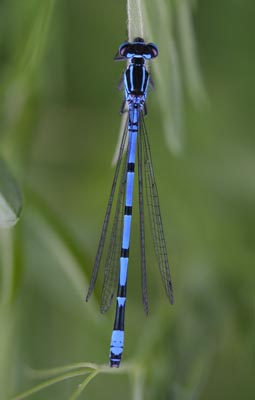
A few more damselflies today; first a male Azure Damselfly:

And a female Large Red:
Hawthorn blossom, or 'May':

The seeds of Cow Parsley are already forming. These look like beetles complete with antennae. When they eventually turn black, the resemblance is even more convincing.

The next major flower to appear on the hedgerow is Meadow Vetchling, or Meadow Pea. The emerging shoots are very distinctive with their flattened appearance:
A couple of days ago I showed some Lady's Smock - Cardamine pratensis - with four Orange Tip eggs. This is the same plant with a roosting male. The attraction of the plant to the butterfly is extremely strong: most of the roosting specimens I find are on Cardamine.

Thursday, 27 May 2010

Another book

A second book containing my photographs was launched today:

This book is the result of a project that brought schoolchildren and 'silver citizens' together to gather memories of how plants were used as food and medicine in times almost forgotten. I think it turned out really well.

This is exactly what I expect to see at this time of year:

No fewer than four Orange-Tip eggs on one flowerhead. I already mentioned that these are cannibals and that only one egg is normally laid per plant. But at this time of year, when the last, late, females are laying, all the plants are occupied so we see a 'dumping' of eggs in the hope that some might survive. Timing is everything: if you emerge too late, the flowers will all be occupied and your offspring will have a poor chance of success. Lateness is a trait that won't pass through to successive generations.


The first of the 'Blue' Damselflies emerged today, just as we were getting the first rain in perhaps a week. This female was using the curved leaf of Cocksfoot as an umbrella:


Here's a closeup showing the 'umbrella' in use:

Female blue damselflies are particularly tricky to separate, but I'm tending to favour Variable Damselfly - Coenagrium pulchellum - for this one. New to me, if so.