Thursday, 21 March 2013

Dead but not forgotten

I stumbled across the remains of a dead tree and was delighted to find it was covered in different fungi. 

The first thing I noted was Daldinia concentrica, more popularly known as King Alfred's cakes:

Daldinia concentrica - King Alfred's Cakes
They range in size from golf-ball to cricket-ball and most definitely look like burnt cakes. Surprisingly, this is the first time I've seen it, although I've been aware of its existence for some time. Specimens of Daldinia are very tough, and it's no great surprise to learn that they are the favoured (sometimes only) dwelling-place of various beetles. New to my Species list.

Notice the turquoise area of bare wood to the left. That's Chlorociboria aeruginascens, also known as 'Green Oak' (although I initially thought my dead tree was Beech, and Chlorociboria aeruginascens is sometimes found on Beech, as is the Daldinia):

Chlorocibaria aeruginascens - 'Green Oak'
Green Oak was very popular for use in Tunbridgeware due to its bright green/blue addition to the more usual cream, yellow and brown of wood colours. Note the small holes in and around the green area, showing that the dead wood is home to more beetles. The beetles and fungi are doing what they do best: recycling dead wood and returning it to the soil. Also new to my Species list.

I also found patches of Flammulina velutipes in various places on the tree:

Flammulina velutipes - Velvet Shank
Its common name Velvet Shank is a translation of the latin velutipes, indicating the dark, velvety stipe ('stem'), although I have noticed in the past that many specimens actually have a pale, smooth stipe. Just to be sure, I put a couple of specimens on a glass slide and they reluctantly dropped a few white spores for me:

Flammulina velutipes spores at x 400
If you find an orange fungus on dead wood and it throws white spores, you can be pretty sure that it's Flammulina velutipes.

At the bottom of the tree I noticed a single group of Turkey Tails - Trametes versicolor:
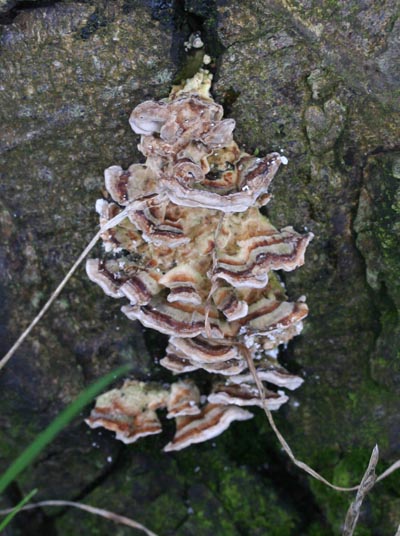
Turkey Tails - Trametes versicolor
The specific epithet 'versicolor' is accurate: I find these in many colours from yellows, greens, cream and white through to reds, black and brown.

So that's a few more specimens for the 1k challenge, including two 'lifers'. The challenge total is now 218 species.

Wednesday, 13 March 2013

Surprises

In my last post, I showed the buds of Barren Strawberry. The flowers have now opened:

Barren Strawberry
As I was taking the shot, my eye was attracted to a flash of purple to my right and I saw the first flowers of Germander Speedwell:

Germander Speedwell

The second surprise for today was the sudden appearance of the Scarlet Elf Cap - Sarcoscypha austriaca var. austriaca:
Scarlet Elf Cap
This isn't a scarce species in damp woodland at this time of year, but it's the first time I have seen it on this patch.

Third surprise was this little Sepsid fly:

Sepsis punctum
Sepsids are known as 'Semaphore flies' due to their habit of waving their spotted wingtips up and down in some sort of signalling ritual. This one was busy cleaning itself, so I'm pretty sure it had just emerged, triggered by the warm sunshine. New identification.

Next surprise was the Cow Parsley beginning to open. I don't normally expect to see that until April.

Cow Parsley just opening
When looking at flowers, I always check for miners, and sure enough, the usual suspect was present and correct:

The mine of Phytomyza chaerophylli on Cow Parsley
You can just make out the shiny black pupa at the top of the mine.

Staying with miners, I noticed this odd mine of the micromoth Stigmella aurella on Bramble:

Badly-formed mine of Stigmella aurella
This one made its first wrong turn when it met the second vein and turned back on itself, and compounded this with another wrong turn as it returned to the first vein. It has now gone into a decreasing spiral and has run out of food. That's one genetic experiment that won't be passed on to future generations.

The frogs in the ditch have finally spawned:

Frogs (left) and spawn
This is approximately two weeks later than I would normally expect, although the adults have been around for at least 3 weeks.

My search for species for the 1k square challenge has now reached just over 200 species in a week, with very few new additions to the square apart from the Sarcoscypha and the Sepsid.


Thursday, 7 March 2013

New challenge

I have decided to join the 2013 'Pan-species list for a 1k square' challenge. Basically, this is a record of all the species that are found in a 1 kilometre square of my choice during 2013.

The 1k square I have chosen is centred around C 256 038, and I have chosen it because it contains a very wide cross-section of habitat types from hedgerow to woodland, ancient walls, bog, rough pasture and a stream.

The progress can be found under the '1k challenge' tab at the top of this blog.

Although I'm starting late (7th March) I don't think I'll have missed too many species during January and February.

Today I walked the route for around 50 minutes and recorded 75+ species in that time. (I still have a couple of things to put under the microscope). I will have missed many more species and will update the list as I do the transect on my frequent walks in that area.

I plan to record everything that I can identify, from birds and animals through flowering plants, trees, insects, fungi, mosses, liverworts and lichens, so I expect to compile a list of several hundred species by December.

The progress of other participants, along with a 'league table', can be found at: http://1000for1ksq.blogspot.ie/


Wednesday, 6 March 2013

The signs are there

We have rain forecast for the next few days, so I took the opportunity to see what signs of spring I could find.

7-Spot Ladybirds hibernate as adults, so in theory they can be seen at any month of the year if the weather is warm enough. But I like to think that the first sighting of the year is a sign of things to come:

7 Spot Ladybird
Many plants are still in their purely vegetative state, but quite a few are making flower buds or new growth. I always consider Barren Strawberry to be the first true flowering plant in each year. True, Celandines will always flower first, but since they can flower any time from November onwards, the Barren Strawberry is my 'first flower' in any given year:

Barren Strawberry flower bud
The plant at top right of that shot is Germander Speedwell which had a very good year last year:

Germander Speedwell

The lowest stem in that shot shows the diagnostic paired lines of hairs that run along the stem.

Bush Vetch is also pushing through the dead fronds of last year's Male Fern:

Bush Vetch
It will be another 4 months before Slender St. John's Wort is in flower, but already the new growth is forming:

Slender St. John's Wort

I cropped this shot of Opposite-leaved Golden Saxifrage to show the rear wall of the ditch covered in liverworts and mosses:
Opposite-leaved Golden Saxifrage with liverworts and mosses
The main liverwort is Conocephalum conicum ('Snakeskin Liverwort') and the tiny moss is Plagiomnium undulatum.

A few years ago, one of the few local areas to have wild Reedmace was excavated to see if it would be suitable for building a house (it isn't!). Most of the Reedmace disappeared, but some has now made a recovery:

Reedmace - Typha latifolia
Typha is the sole host family for many insects, including some moths and hoverflies. I examined quite a few specimens of the Reedmace for any signs of those species, but none were found. I wonder how long it will take for them to return (if they ever do).

No time is ever wasted in nature: the leaves of Lesser Celandine are hardly full-grown and already the fungal rust Puccinia ranunculi has taken hold.

Puccinia ranunculi on Lesser Celandine

Last year there seemed to be a very wide-ranging absence of fresh mines of the micromoth Stigmella aurella from its main foodplant, Bramble, and I certainly found very few.  So it's good to see a good number of fresh mines (fresh mines are white, whereas old mines from previous years are brown) on the host plant this year:
Mines of the micromoth Stigmella aurella
There are 4 mines on that leaf, all of which appear to have grown to full size. I'm always entertained by the way the mines progress without falling out of the edge of the leaf and also how they seem to detect other mines and take avoiding action before they intersect them (or their own!), especially when older.

Tuesday, 26 February 2013

Blue skies smiling at me

We rarely have high pressure weather systems over Donegal, but the past week has been like this:


Con-trail over Mongorrey
High pressure at this time of year produces sun during the day and frost at night, so we have had a couple of nights with -4 and -5c, but the days are warm enough to bring out the first insects.

I can almost predict that the first hoverfly of the year will be a female Eristalis tenax, and sure enough, I spotted this one today on a Dandelion:

Female Eristalis tenax on Dandelion
Females of Eristalis tenax overwinter as mated adults, so they are ready to produce eggs as soon as it's warm enough. Related Eristalis species overwinter as pupae, so although the tenax females have a head start, they are at risk if the winter is very cold.

I went up to see if there was any frog spawn at the usual places, but none was visible, although I have seen a few frogs at night. I did, however, see a few midges in loose clouds:

Midge cloud

This is still a good time of year to see lichens before the green growth obscures them. I found a large specimen of Peltigera membranacea (Rabbit's-Paw Lichen):

Peltigera membranacea - 'Rabbits-paw lichen'

The underside of the thallus is covered with spiky rhizines, which are used as anchors:

Rhizines on the underside of the thallus of Peltigera membranacea
There are quite a few different species of Peltigera on the patch, but P. membranacea is easily distinguished by the pale blue thallus.

Evernia prunastri can be distinguished from other similar species by the twin-forked branching structure:

Evernia prunastri on Willow
Cladonia portentosa is most often seen apparently growing on the ground amongst mosses and heaths, but it's actually growing on buried wood. This specimen is growing on a badly-decomposed log:

Cladonia portentosa on decayed log
Night brings out the spring moths, and my first for the year is the Dotted Border:

Dotted Border moth
The Dotted Border feeds on a wide range of broad-leaf trees as a larva. I'll leave you to work out where its name comes from.

Here's the result of living in a wet climate:

Peziza domiciliana

Peziza domiciliana is a fungus which is most commonly found indoors, growing through concrete. This specimen is happily growing in the boot of my car.

New to my species list (and not previously recorded in Ireland, although I find that difficult to believe).


Thursday, 14 February 2013

Ashes to ashes

Last night, I found a newt lying apparently dead on a country lane. I picked it up and it moved a little, so I decided to take it home to check for damage (a car had just passed):

Male Smooth Newt


It seemed ok and survived the night, so I took it up to the local stream and released it there.

The stream runs alongside a country lane that is edged on both sides by Ash trees:

Craigs Road with Ash trees
Given that Chalara fraxinea has been detected not far from here, I rather suspect that these trees won't last much longer (hence the title of this post). This will, of course, be disastrous from the perspective of the trees, but Ash isn't the obligate food source of very many fungi or insects, so the impact on overall biodiversity is not likely to be as bad as it could have been.

The stream runs alongside the right-hand side of the road in the deep shade of the trees, and is a great source of water plants, with numerous liverworts and mosses on the rear wall:

Opposite-leaved Golden Saxifrage with the liverwort Conocephalum conicum
Many of these plants like dark, damp conditions, so I suspect the rear wall flora will be altered until some other trees grow to provide more shade.

The stream is where I always find the first flowering specimens of Lesser Celandine, and a few flowers were just beginning to open:

Lesser Celandine just opening
Just as I was taking the above shots, I heard the unmistakeable deep croak of the Raven. I looked up and saw a pair circling overhead:

Ravens over Craigs Road
They circled and kept me in view for quite a while before flying off west. I managed this shot showing the very distinctive tail:

Raven
At the top of the stream, where it emerges from an underground run, there is a wall that is always good for a few moss shots. This is a back-lit shot of Tortula muralis:

The moss Tortula muralis
I like to think that the setae (the 'stalks' that hold the capsules aloft) are light pipes, driving sunlight directly to the interior of the plants.

The capsules of many mosses are held well clear of the foliage in order to enhance the chances of spore dispersal, but Grimmia pulvinata continues to puzzle me with its insistence on keeping the capsules buried deep under the leaves:

Grimmia pulvinata, with buried capsules
You can just make out the brown capsules in that shot.

This shot of Barbula unguiculata would make a nice banner for somewhere:

Barbula unguiculata

 On the other side of the road, we have an untended copse where dead wood is ideal for fungi. This white crusting fungus is Meruliopsis corium:

Meruliopsis corium

There are also a few patches of Snowdrops in the same area:

Snowdrops
A quick check on the Willows showed that the catkins are well advanced, so perhaps spring is on the way after all.

Willow catkins

Saturday, 2 February 2013

The birds

It seems that my prediction of a locally mild winter has been fairly accurate so far: we have had a few nights with frost, but rarely anything below -2. One night delivered a couple of centimetres of snow, but it lasted barely a few hours. We have, however, had fairly unrelenting rain with dark skies and terrible light.

Buzzards are a fairly common sight in the area, and we often have a couple flying directly over the house as they circle looking for prey. A pair decided to survey the local rookery, so I tried to get a few shots. As soon as you point anything at them, they make a dash for cover, and this is the shot I got as they flew round the other side of my house:

Buzzard
The sky is the colour that I have become familiar with over the last 40 days or so.

When we arrived back from shopping today, I noticed a Song Thrush lying beside our front doorstep. It seemed to be in some distress, but it didn't move as I rattled off a few shots. After I put the camera down, I approached it to see if it had any injuries, but it flew off, apparently in good order. On close examination of the photographs, however, I see that there are injuries to each side of the head, as shown in the following shot:

Injured Song Thrush
Those injuries are indicative of a predator of some kind, but I don't think that our local cat has a mouth large enough for that.

Another mystery.

Interestingly enough, this is a new addition to my Species List.