Friday, 27 July 2012

Signs of high summer

Much of our wildlife is seasonal, with some flower species in bloom early in the year, but others waiting for late summer before they appear. Similarly, some insects are clear indicators that the season is progressing towards its inevitable close at the end of the year. So it is always with mixed emotions that I greet the flowering of Wild Angelica. Angelica is a wonderful source of nectar, so much so that I can find a single flower-head with perhaps 40 insects feeding on it at any one time. Sometimes there appears to be some kind of truce in operation, where predators and prey feed side by side without much aggression being shown, but other species have no such intentions and use the busy flowers as a richly-populated hunting ground. The first heads of Angelica opened this week, so hopefully I'll have some images to show from it in the next few days.

Marsh Cinquefoil is one of the later-flowering species from the patch down beside the bog:

Marsh Cinquefoil
Although it shows some structural similarities, it's quite different from its close relatives Tormentil, Silverweed and even Barren Strawberry, all of which flower in close proximity.

It took me quite a while to realise that all of my local Birdsfoot Trefoil specimens are actually Greater Birds-foot Trefoil:

Greater Birdsfoot Trefoil
I always find Birdsfoot Trefoil near the coast, where it is a much lower plant, almost creeping and prostrate and flowering much earlier, from May onwards. I just assumed that the early flowering was due to coastal warming, but when I began to investigate my local specimens (which flower about now), I found they were all Greater Birdsfoot Trefoil. The plant is much taller and larger in almost all its parts, although the flowers are in clusters containing more flowers than Birdsfoot. The clincher, though, is to sever the stem and examine the cross-section. Greater is hollow, whereas Birdsfoot is solid.

The appearance of Dock flowers is another sign that the season is progressing. These are the (surprisingly beautiful) flowers of  Curled Dock:

Curled Dock flowers

Given the amount of rain we've had, I have seen very few of the larger fungi so far this year, although the usual rusts are all present and doing well. Ergot is also quite prominent on grasses:

Ergot on Sweet Vernal Grass
Ergot is a fungal parasite on grasses, and contains a number of toxins which can cause a wide range of serious effects on humans or other animals that ingest it. These effects range from circulatory problems and neurological imbalances through to hallucination, limb loss, heart damage and spontaneous abortion. Unfortunately for people in the middle ages, cereal crops such as Rye and Barley are grasses affected by Ergot.

St. Marks flies (Bibio sp.) are usually found at the end of April (and I showed a couple at that time), but the red-legged Bibio ponomae emerges in later summer. This is a female:

Bibio pomonae (female)


In common with a number of other butterflies, Green-veined White has two or even three generations per year. This is the first of the second generation that I have seen this year:
2nd generation Green-veined White butterfly


The hoverfly Episyrphus balteatus is readily recognised by the alternating narrow and broad black bands on the abdomen:
Episyrphus balteatus (male)

And this is a little portrait of one of the grey-banded species - Platycheirus albimanus (female):
Platycheirus albimanus (female)


Despite the damp weather, a few interesting moths have come to light. This is the Satin Beauty:

Satin Beauty moth
It's not quite as beautiful as its relatives, but it is an increasing species. It's dependent on conifers, and has spread along with the growth of coniferous plantations.

The Common Wainscot feeds on various grasses as a larva:

Common Wainscot moth

The July Highflyer can be distinguished from other similar species by the diagonal dark slashes at the apex of the wing tip.
July Highflyer
This species has a wide range of larval foodplants, from Willows to Heather, Spruce and Bilberry.

Many of the micromoths can rival or even exceed the beauty of their larger macromoth counterparts. Dipleurina lacustrata is a good example, although it's only 9mm. long:

Dipleurina lacustrata

The first of a couple of new species for me. First, the Fan-foot:

Fan-foot moth
New to my species index.

And a very atypical Square-spot Rustic:

Square-spot Rustic
New to my Species Index.

The Square-spot Rustic feeds on various broad-leaved trees, whilst the Fan-foot is a recycler, feeding on withered and fallen leaves.


Saturday, 14 July 2012

A little heat

When it rains, flying insects - quite understandably - keep a very low profile, and once the rain stops it takes a couple of days for them to emerge in any great numbers. After a couple of dry days, though, it seems that we have had a fresh start and everything is out again.

True Crane Flies are recognisable by their very long legs:

Crane fly Tipula fascipennis (female)
The larvae of Craneflies are the 'leatherjackets' that eat the roots of grasses, and can remain underground for over a year.

There are many species of Cranefly, and distributions are generally governed by availability of the favoured foodplant. The specimen above has a very distinctive white flash that extends to both edges of the wing, leading us to Tipula fascipennis. New to my species list.


Sexton Beetles are the great recyclers: they search out decomposing animal bodies and partially bury them by excavating beneath them. Their larvae then feed on the decomposing flesh, leaving the remnants of the buried corpse to return to the soil.

The Sexton Beetle Nicrophorus investigator

Speckled Wood butterflies are usually the first spring-emerging species that I see in any particular year, and the first generation lasts perhaps 6 weeks. Then, after a gap, their offspring emerge as a second generation:
Second generation Speckled Wood butterfly
If conditions are favourable, a third generation may appear around September.

I happened to notice today that Foxglove flowers are hairy inside:

Foxglove flowers

I can't really work out a reason for this (the just-visible orange reproductive parts are on the upper side of the tube). There would be no point in scraping pollen off onto the floor of the tube, so maybe it's just a doormat. (Late thought: the only insects that can successfully pollinate Foxgloves are those large enough to gather and transport pollen on their backs:  Bumblebees are an obvious candidate. So perhaps the hairs prevent smaller insects from stealing pollen without delivering any in return.)

Continuing my short series of grass images, this is False Oat-grass:

Flowers of False Oat-grass
Grasses do bear some serious examination: some of them are truly beautiful.

Dry nights usually mean a decent set of moths attracted to my lights at the front door. The newer energy-saving bulbs seem to attract more moths than the old tungsten filament bulbs, so it's a win-win set up.

This is the Clouded Border, which is one of the moths that looks most like a butterfly.

Clouded Border moth
The Flame Carpet has a bright orange-red central band on the wing which fades very quickly, especially if there has been any rain:
Flame Carpet moth
The Snout can be readily identified by the long mouthparts:
Snout moth
The Mottled Beauty can be separated from similar moths by the sickle-shaped leading part of the dark wing band:
Mottled Beauty
This next specimen caused me a bit of a problem - the markings look like scribbles - but it turns out to be a rather worn Double Dart, and is new to my Species list.
Double Dart moth


Tuesday, 3 July 2012

Research time again

A low-pressure weather system appears to be stuck over Ireland at the moment, so there has been plenty of rain (I blame Wimbledon). That means I have had some time to look at previous identification problems, and I have managed to identify a leaf-hopper that I found in July 2009. It's the Potato Leafhopper - Eupteryx aurata:

Potato Leafhopper - Eupteryx aurata
It's one of the few leafhoppers that have a common name, presumably because it is said to be a pest on potatoes. (It's interesting that the few fungi or insects that have been assigned 'common names' are the ones that we find most threatening. Death Cap and Destroying Angel come to mind.)

Identification new to my species index, which now stands at 1431 species.

Thursday, 28 June 2012

Orchids and grasses (and a moth)

My local Spotted Orchids have started to flower - albeit a bit later than usual. The three main 'species' that I have locally are:

  • Common Spotted Orchid (CSO) - Dactylorhiza fuchsii
  • Heath Spotted Orchid (HSO) - Dactylorhiza maculata
  • Northern Marsh Orchid (NMO) - Dactylorhiza purpurella
These three freely hybridise with each other, and the hybrids back cross with the parents and with the other hybrids, so it is very rare to find a 'pure' or clean specimen anywhere: each specimen is likely to bear a component of each of the species in varying proportions. For that reason, the taxonomy of the two spotted orchids keeps changing, with them being variously described as species, subspecies or variants. But I just describe them all as hybrid spotted orchids. I recently had a long conversation with a leading orchid specialist, and when I asked him why we continue to try and name each specimen as A), B) or C), he said "it's just because we like to give different names to things that look different from each other, but really they're all hybrids".

I also have a suspicion that some of the variation is caused by the very local microclimate, for example if the orchid is standing in water or has dry feet. I generally find that specimens in water look more like HSO, but drier ones look more like CSO. The natural assumption is that HSO prefers water, and CSO does not, but if the water dries out for any reason, then the specimen that looked like HSO one year will look more like CSO the next year. I call these variations 'ecomorphs'.

Hybrid Spotted Orchid
That first one has features of CSO (the long tooth at the front lobe of the flower) and NMO (the overall colour is quite dark). The edges of the lip are slightly frilled, so there's some HSO in there, too.

And here's another:

Hybrid Spotted Orchid
That one has stronger frills and a paler colour, so I'd say 50/50 HSO and CSO.

These specimens were photographed at their best: the lower flowers have just opened and the higher flowers are still buds. When the flowers are all open, I think the plant looks less attractive.

I'll show more as I find them.

Grasses can be fun to identify, and the good news is that although the initial identification might be tricky, many species are readily identifiable in the field. One key feature is the 'ligule', which is formed where the leaf touches the stem:

Long, pointed ligule of Rough Meadow Grass - Poa trivialis

The long, pointed, ligule in the above specimen points us to Rough Meadow Grass - Poa trivialis.

Here's the grass:

Poa trivialis - Rough Meadow Grass
Crested Dogstail is easily identified by the one-sided nature of the seedhead (although I did manage to mis-identify it on another blog the other day):
Crested Dogstail
Cocksfoot is very recognisable:
Cocksfoot
While we're on Cocksfoot, I'll show this picture of one of the 'Minor' moths. There are three Minor species which are extremely difficult to separate, so unless we capture and kill them, we have to record them as 'Minor agg.':
Minor agg. moth
Minors use Cocksfoot grass as a food, living inside the stems when at the larval stage.

Yorkshire Fog must be the most common grass in this area: I find it in all but the wettest environments:

Yorkshire Fog
I just noticed the Rye-grass at the front left of the image.

The flowers of Meadowsweet have just opened and their perfume will dominate much of the hedgerow for the next couple of months:

Meadowsweet
Meadowsweet must be particularly nutritious: there are many species of insect and fungus which feed on all parts of the plant.

Now: hands up all those who ignored (or missed!) the Puccinia graminis rust on the Poa.

I was recently invited to talk about my blog by Nature Center Magazine. You can see the interview here. Thanks to Emma for that.

Tuesday, 26 June 2012

Opportunistic shots

The weather has continued to be cold or dull or wet, or all three at the same time, but I suppose it isn't only us this year.

Scaeva pyrastri is thought to be a migrant hoverfly - at least for the first generation - in Ireland, but I suspect that as we get warmer, then it might well join the growing list of insects that have become winter-resident, like the Red Admiral butterfly, for example. I was just saying the other day that when I was younger, books seemed to have facts in them, nowadays they seem to contain mere guidelines, because so much is changing so quickly.

I spotted this female Scaeva pyrastri hoverfly as she examined each flower stem and seedhead for aphids:

Female Scaeva pyrastri hoverfly ovipositing

Every so often she would stop and lay an egg in amongst any aphids she spotted.

I checked one batch of aphids after she had moved on, and sure enough, I could see the egg - apparently directly on top of an aphid - arrowed in this shot:

Scaeva pyrastri egg (arrowed)
Male hoverflies are known to hover for a variety of reasons, such as protecting territory or showing off their skills to attract a mate, but this female was hovering very accurately as she minutely examined the flower stems and seedheads from around 10mm away. The Small Heath butterfly is very particular about its habitat: it likes heathy areas with shorter grass, but I'm sure it has some other requirement that we don't know about, because many apparently suitable habitats are ignored by them. I had always thought that one particular area on my patch was suitable, but it was only after 8 years of searching that I found a single specimen there last year. A couple of sightings at the same location this year - including the one in the shot - suggests that a colony has now been established:


Small Heath butterfly
It's a lovely little butterfly, and a welcome addition to my local list.

Syritta pipiens is readily recognised by the inflated thighs on the rear legs:

The hoverfly Syritta pipiens, female
A few moths have been brave enough to beat the rain, although reports of populations are far lower than normal, sometimes as low as 10% of the expected numbers. The Hawkmoths are our most stunning moths, and I was fortunate that this Poplar Hawkmoth came to light:

Poplar Hawkmoth

These are as large as smaller bats, and on a 17" screen at 1024 x 768, that picture isn't much larger than life size. The Poplar Hawkmoth larva usually feeds on Poplar, but hereabouts it will be Willow. Notice that the wings of this species at rest are held in a very unusual configuration, with the rear wings ahead of the front wings.

The Common White Wave is a handsome little moth:

Common White Wave moth

This species is distinguished from the Common Wave by the almost-straight rear grey lines on the forewing.

This weevil caused me a bit of pain during the identification process. Most web references say that it is associated with Dog's Mercury, which doesn't grow around here. It keyed quite quickly to Barynotus moerens, but with all the web references stating that it was associated with a single plant, I retried the identification several times to see where I had gone wrong. 

The weevil Barynotus moerens
After much angst, I found that it is also associated with Ground Ivy, which we have in abundance around the patch. I think many websites (and some reference books) just copy what they read elsewhere without examining the facts.

New to my species list.

Wednesday, 20 June 2012

Old and new

The weather continues to be odd: very heavy showers interspersed with brief (and unexpected) blue gaps in the cloud.

Plants are making their usual growth, but insects are finding it hard to get going, since they must shelter from the rain and emerge only when it's safe to do so.

My first shot today is a hoverfly which is highly distinctive and new to me:

The hoverfly Chrysotoxum bicinctum
Chrysotoxum bicinctum is easily recognised by the wide yellow bands on tergites 2 and 4, with an occasional thin band on tergite 3. The front half of the wings are dark brown, although that's difficult to see from the shot above. The biology of Chrysotoxum sp. is largely unknown, but the larvae appear to be associated with aphids, particularly those in association with ants. There is a lot out there that we just don't know enough about. Handsome beast, anyway.

The next specimen is probably new to me as well, but without capturing the specimen I can't be sure.

Platycheirus ?fulviventris

It's certainly Platycheirus sp. but I couldn't get a good enough view of the front feet to confirm, although I did get a good view of the dark yellow/orange abdominal patches in flight. Looks to be Platycheirus fulviventris, but could be a couple of others.

The effects of rain are clear in this next shot of what appears to be the solitary bee Andrena cineraria (male):

Andrena cineraria (male)

Male Andrena sp. are very difficult to identify, but this one seems fairly safe, due to the ash-grey hair on the thorax. These have come to the end of their season, now.

There seems to have been a sudden hatch of Helophilus pendulus: I saw dozens today:

The hoverfly Helophilus pendulus (male)
Note that Helophilus sp. are different from other hoverflies, in that the eyes of the males don't meet in the middle. There is, however, a small kink in the leading edge of the eye, which is missing in the female.

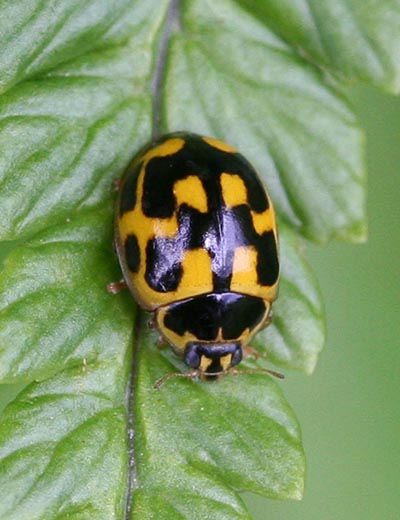
This 14-spot ladybird caught my eye:

14-spot Ladybird
These are much smaller than the more common 7-spot, being roughly the same size as a match-head.

Finally, most people will be unaware that Cleavers - variously known by other common names, usually involving the word 'sticky' - has flowers:

Flower of Cleavers
Cleavers is a member of the Gallium family, which have 4 pointed petals. You can see the hooked seeds just behind the minute flower.

Monday, 18 June 2012

Gap in the clouds

An unexpected gap in the clouds prompted me to visit our highest local point in search of orchids.

Northern Marsh Orchid is the first of our local Dactylorhiza orchids to open:

Northern Marsh Orchid
All of the Dactylorhiza orchids freely hybridise with each other in a fertile manner, so I always like to assign a percentage of the three local 'species' which appear in any specimen. The first specimen, above, is very close to the 'clean' specification, (short spike, dark flowers, clean edge to lip of flower) so it is mostly Northern Marsh orchid.

The next specimen is paler and has a slight tooth to the front edge of the lip, so I'll give it 90% Marsh and 10% Common:

Northern Marsh Orchid with signs of Common Spotted Orchid

This third specimen is clearly a hybrid with Common Spotted Orchid (tall spike, still paler flowers, visibly sharp tooth):

Northern Marsh Orchid x Common Spotted Orchid

I'm pretty sure that third one has some Heath Spotted Orchid in it too.

Interestingly enough, the hybrids tend to follow the flowering dates of their major partner: Northern Marsh Orchid is always around 3 weeks earlier than Common Spotted or Heath Spotted, with hybrids somewhere in between, so it's not only physical characteristics that are shared. My 'clean' Spotted orchids are only starting to make spikes now.

I was astonished to also find a Common Twayblade orchid in this location:

Common Twayblade

I strongly associate Common Twayblade with limestone, so the road in this area must have been fortified or built with limestone chips, since this location is in a strongly acidic heath area. We need to be alert to just how much our actions can affect populations of plants (and hence insects).

Staying with the theme of habitat alteration, this part of the heath has become overrun with False Salmonberry:

False Salmonberry

False Salmonberry is an american rubus species that was introduced in Northern Ireland to support game birds for shooting. I first saw it locally about 5 or 6 years ago as isolated specimens, but now it has covered acres of heath, eliminating native species as it spreads. It is clear that this is yet another highly mobile and invasive plant.

Bumblebees that are brighter than usual tend to be males, especially if they have yellow hair where black would be expected.

Male Bombus lucorum
The tuft of yellow hair on its 'nose' is a clear indicator, but the overall colouring (in association with the absence of pollen bags from the hind legs) leaves little doubt. The flower is Common Catsear.

The hoverfly Sericomyia silentis is an excellent wasp mimic:

Sericomyia silentis hoverfly
It's quite a common hoverfly, but I rarely see it in large numbers.