Friday, 23 September 2011

Fungal season

Fungi are popping up everywhere, so it's time to get the microscope dusted down, ready for the new season.

The mushrooms that we see are the visible fruit-bodies of the actual fungus, which is usually underground or buried deep inside some substrate, such as wood. The fungus itself will stay in the same place as long as its partner or food source continues to be available: that explains why a particular mushroom can continue to be found in exactly the same location year after year. I'm now beginning to expect my usual crop of Phaeolepiota aurea on the same spot on my lawn at the same time every year. This is a rather scarce mushroom, which is thought to be a nettle associate:

Phaeolepiota aurea
At the beginning, the underside is completely sealed, providing a secure environment for the spores to develop:
Phaeolepiota aurea

Later on, the seal drops to form a ring and the millions of spores are released to be carried by the wind.

Recent studies on Phaeolepiota aurea have confirmed that compounds of cyanide remain in the mushroom, even after cooking, so it has been added to the list of 'poisonous' fungi.

I have previously written about the structure of lichens: fungi which have captured algae in order to utilise the energy that the algae can generate from sunlight. Essentially, lichens cannot survive alone: they need their algal partners to supplement their food supplies. What is particularly interesting, however, is that some fungi can be part-time lichens: most of the time, they survive on their own food resources, but they can capture algae on a temporary basis in order to survive transient periods of hardship. A number of fungi can do this, but it is the Omphalina family which is best known for it.  Omphalinas are small, delicate, trumpet-shaped fungi that are associated with mosses. This specimen is about 8mm. across the cap:

Omphalina griseopallida

I know of a few Omphalina species in my area (we have lots of mossy locations), but this one is new, and looks most like Omphalina griseopallida. I'm taking a spore print to see if that helps with the identification.

Spore prints are one of the basic tools in identification of fungi, and the spores of some species give very strong clues about an identification. This is the spore print of a new species to me: Stropharia aurantiaca.

Spores of Stropharia aurantiaca at x400

Stropharia aurantiaca is a relatively recently-named (1930's) fungus which appears in bark and sawdust that has been used as a top-surface mulch on flowerbeds. In this case it's in a local supermarket car park It has been found numerous times in Northern Ireland, but I can't find any previous records from Ireland.

I'll try to get an in-situ shot later today.

Monday, 19 September 2011

Post hurricane post

The weather continues to be hateful, but I'm guessing that everyone has been in much the same position.

I went up to the boggy area which has many specimens of the late nectar source, Devilsbit Scabious, and found this specimen of the hoverfly Sericomyia silentis. For those of you who know the size of the flowerhead, it will be apparent just how large this hoverfly is.

Sericomyia silentis on Devilsbit Scabious
Devilsbit is a plant that loves damp, acidic soil, in complete contrast with its close relative, Field Scabious, which needs alkaline soil. Interestingly enough, I sometimes find an occasional specimen of Devilsbit Scabious which has the same colouring as the lime lover:

Pink form of Devilsbit Scabious

It's still 100% Devilsbit, though.

Staying with Devilsbit, I found a few rather interesting specimens that were making an extra flowerhead from an existing one:

Devilsbit Scabious with 'extra' flowerheads

Notice the second 'offshot' appearing to the lower left of the central flower. This phenomenon wasn't restricted to one area of the bog: I found multiple specimens spread over perhaps 200 m.

Some specimens of Angelica have survived the storms: these are mostly ones in very sheltered locations. Specimens out in the open have all snapped at ground level. This flowerhead had a number of Ichneumonids still nectaring on it. There are 3 in this shot:


Actually, I just spotted a fourth, right at the bottom of the shot.

This area has quite a few Scots Pines, and I found a few specimens of Suillus flavidus and its bigger brother Slippery Jack, which are always found in association with Pine. I also found the usual swarm of Hebeloma mesophaeum all the way along the edge of the access road:

Hebeloma mesophaeum 
The mosses are Pleurozium schreberi (red veins) and Rhytidiadelphus squarrosus (green 'stars' at 4, 6 and 8 o'clock).

I recently showed a specimen of the leafhopper Cixius nervosus, but I thought this one showed off those wonderful wing veins at their best.

Leafhopper Cixius nervosus
Leaf hoppers - like so many other true bugs - are quite difficult to separate, but the main identification features are visible in this shot.

1) There are 3 'keels' on the thorax.
2) The black dots on the wing edges are larger than those on the inside veins of the wing
3) There is a rather distinct black bar across the front third of the wings.
4) The area between the eyes and the thorax is brownish-yellow.

Let's hope next week's fungal foray isn't rained off.


Monday, 5 September 2011

New Science

Salmonberry - Rubus spectabilis - is a highly invasive member of the Bramble family - originating in western North America - that was originally brought into Northern Ireland as cover for game birds. I saw my first specimens about 5 years ago in a couple of places, but now it's appearing almost anywhere I look in higher locations. The flower is a bright purple, and the berry is a salmon-pink colour (and is incredibly bitter, as I found out to my cost).

I examined a few plants recently and found a couple of leaf-miners:

'Agromyza ideana' on Salmonberry


'Stigmella aurella' on Salmonberry

The first specimen looks very much like Agromyza ideana, which is usually found on Raspberry, and the second looks like Stigmella aurella, which is found on Bramble. The current literature for miners in Ireland and Britain doesn't contain any records of these miners on Salmonberry, so these relationships are both new to science. (The European literature also has no entries for Stigmella aurella on Salmonberry, so that would likely be new to European science). Both mines are well-developed, indicating that these species will be successful in this new host. I'll have to write this up for the appropriate journals once the identifications have been confirmed by the appropriate experts.

Staying with mines, I checked a stand of Bracken where I had previously found my only specimen of the leafmining fly Chirosia histricina and I found it once again:

Chirosia histricina on Bracken

Underside of Chirosia histricina
Given the amount of Bracken that doesn't have this miner, it seems to have very specific microclimate requirements. The literature says 'shady places', and this is under Ash on a north-facing bank, which would certainly qualify as a shady location.

I was actually on a fungus hunt, but I didn't find much of interest in that respect. I did, however, spot a few specimens of the excellent bumblebee-mimicking hoverfly Arctophila superbiens:

Bumblebee-mimicking hoverfly Arctophila superbiens

I had only ever seen this species once before, in a location some 40 km away, so I was delighted to find it on my local patch. Identification is mainly from the very dark wing shade, the all-black legs and the orange hair on the thorax, whilst the abdominal hair is grey.

I coincidentally spotted the bumblebee which the hoverfly is mimicking - Bombus pascuorum - which is still around, but in decreasing numbers as autumn creeps in:

Bombus pascuorum on Devilsbit Scabious
The mimicry is very well-developed here, right down to the grey patches at the base of the wings.

I also liked this shot of the female Cranefly, showing those incredibly long legs:

Female Cranefly

Eyebright is showing all along the centre of paths now:
Eyebright

Eyebright is broken down into a number of species/subspecies. I'm sticking with Eyebright.

A couple of moths came to light on the one night we've had without rain:

Lesser Yellow Underwing

I caught this one at just the right angle to reflect the flash in its eye:
Flounced Rustic


Tuesday, 30 August 2011

Mixed bag

These are the last photographs from my usual stretch of hedgerow for several months. The day after I took these, the hedge was cut down to the ground to a distance of a metre from the road on each side for 200 metres. So there won't be anything worth posting from there until next spring. I don't know why the hedgecutter chose this totally inappropriate (and illegal!) time to do the cutting ("it's only weeds and bugs"), but we have to live with these decisions. Unfortunately, the wildlife can't.

Last year I showed a photograph of the capsid bug Lygus rugulipennis. This is its nymph from exactly the same area:
Nymph of  the capsid bug Lygus rugulipennis
If you follow the link back to the original picture, notice how different the adult is from the nymph. This is typical in bugs, and makes identification of nymphs that bit more difficult, since it's normally the adults that are shown.

Udea lutealis is one of the larger micromoths, and is to be seen on practically every verge and hedgerow at the moment. The faint pattern diminishes as the moth gets older, and mature specimens (i.e. a few days old) appear to be a uniform cream in colour:

The micromoth Udea lutealis

I spotted this larva of the Sawfly Arge gracilicornis on Bramble. I had hoped to follow its progress for a few days, but that is no longer possible:
Larva of the Sawfly Arge gracilicornis
I should also mention at this point that I will be unable to continue my 5 year study of the sawfly Nematus pavidus this year, since the Willows were also threshed to ground level and won't have leaves until next year. I hope I can find some more specimens elsewhere.

The fungal rust Puccinia graminis infects many different grasses. This infection is on a stem of False Oat grass:

Fungal rust Puccinia graminis on False Oat grass
I haven't seen very many specimens of the wasp-mimicking hoverfly Sericomyia silentis this year. This one was on Male Fern on the other side of a deep ditch:

Hoverfly Sericomyia silentis

Earwigs are universally despised and, I think, a bit unfairly. They are quite unusual in that they tend to stay in family groups, whereas most other insects abandon their eggs/larvae. This is a male (the pincers are curved) Forficula auricularia:

The earwig Forficula auricularia
This one was photographed in my garden: I found it when checking a pot full of Fuchsia cuttings. Notice how small the wing covers (the squarish area next to the middle leg) are. Earwigs can actually fly, but I rather suspect that they are reluctant to do so because the wings have to be folded around 40 times to get them into such a tiny space.

New identification.

Friday, 26 August 2011

An identification

My last post showed images from a woodland ride which is bounded on the northern side by a mature Spruce plantation, and on the southern side by Beech. Over the last couple of days I have been closely examining some more of the photographs, and I realised that I have a very illustrative set of images of one species of hoverfly that was causing me more than a little bit of bother to identify.

This is the first shot:


My initial reaction was "Cheilosia illustrata, but a very bright specimen". So I rattled off a few more shots as it wandered over the flowerhead:


When I examined the photographs back at the computer, I quickly realised that my initial identification was wrong. Firstly, the face is yellow, and there are no grooves running down between the eyes and face:


Those features rule out Cheilosia.

So what is it?

A quick examination of the wing veins ruled out Eristalis sp., because the Eristalis 'bulge' is not present:

Archive image of the distinctive Eristalis 'bulge' 
Here is the actual wing:


The arrow shows another distinguishing feature of the wing, where the marginal vein curves back to make an obtuse angle with the central vein. This obtuse angle rules out Volucella species. Just to confirm, I checked the aristae, which are the small projections on the antennae. The ones on this specimen are simple and not feathered, so that again rules out Volucella species:


Let's look at the legs:


The legs are clearly not all black, so that rules out Merodon species.

I was struggling at this point, because I had ruled out all of the common bumblebee mimics, and the image didn't match any others in the standard reference book.

I decided to bite the bullet and key the specimen from scratch, which led me to tribe Syrphini, and only one member of that tribe remotely resembles a bumblebee, and that is Eriozona syrphoides. A quick check of the species description for Eriozona syrphoides reveals:

"At first sight, Eriozona is like an outsized Cheilosia illustrata, but the face is yellow in Eriozona."

"Most records are for Spruce plantations or deciduous woodland where spruce is present."

"May to October, with a second peak in August".

Things are looking good for Eriozona syrphoides. But it's a rare species, which I had only seen once before, in another Spruce plantation some 30 km. away. I was still a little bothered that the illustrations didn't match, so I did a quick google search of images for Eriozona syrphoides, and it was immediately obvious that there are two distinct colour forms: one that is in the book and matches my first specimen and another, much brighter version, which is the version I found on Wednesday.

So there we have it:

The hoverfly Eriozona syrphoides (male)
Time taken for the identification? Around two hours.

Eriozona syrphoides is a European species new to Ireland (the first sighting was in 1998) and follows on from sightings in England and Wales in the 1960's. It is closely associated with Spruce plantations (the larvae are predators of aphids that feed on conifers), so the species is clearly spreading as Spruce plantations mature. I'm usually very critical of the negative effect that Spruce plantations have on local biodiversity, but in this case I have to make an exception: Eriozona syrphoides is a very handsome hoverfly.

(Late note: I wonder if the two colour forms are male and female, since my previous specimen was a female). More checking.....

Later note: Once I had finalised this identification, I realised that a specimen shown previously from this same location was actually this species. I have amended the previous page accordingly.

Tuesday, 23 August 2011

What's that yellow thing in the sky?

Sun! We had almost four hours of continuous sun today, so I made a bee-line for the Angelica.

I took around 200 shots of whatever looked good, and these are the highlights:

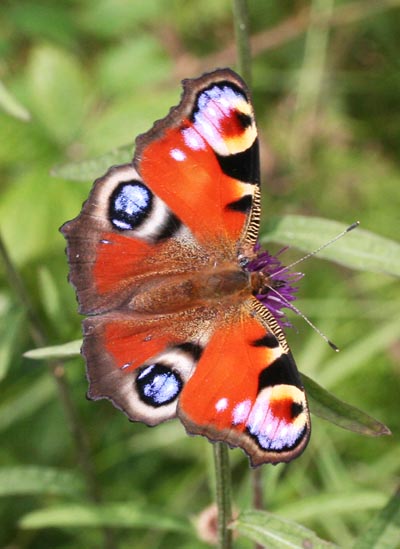
The Peacock is a butterfly that I see quite rarely. I'm not sure if there were a few of them on this woodland ride today, or if the same one was flying along overtaking me from time to time. The Peacock is a nettle feeder and the late summer generation is emerging now. These will overwinter as adults, emerging in spring as soon as it's warm enough:

Peacock butterfly

Sicus ferrugineus is a conopid fly that can often be found crouched on knapweed flowerheads waiting for a bumblebee to land:

The Conopid fly Sicus ferrugineus
These are parasitic on worker bumblebees, but although I saw a good number of Bombus pascuorum workers today, none of them landed near the fly.
Leucozona glaucia is one of the most colourful hoverflies that we have. The combination of blue abdomen, yellow scutellum and shiny brown thorax is quite striking.

The hoverfly Leucozona glaucia
I caught a few glimpses of its duller relative, Leucozona laternaria, which I hope to show soon.

Sawfly larvae can be distinguished from moth and butterfly larvae by counting the number of prolegs. But I can generally pick them out quite quickly by their very round-shouldered appearance:

Sawfly larva on Ribwort Plantain
This close-up shows the semi-translucent nature of the body:
Close-up of sawfly larva
I went through the checklist of sawfly larvae and their host plants, but the only one specific to Ribwort Plantain doesn't match. That probably makes it a generalist polyphage, so the only way to find out what species it is would be to breed it through and identify the adult.

Caddis Flies are often mistaken for moths, especially when they come to light at night. The main distinguishing feature is the forward-facing antennae (although some of the longhorn moths also have this feature, in which case the Caddis Flies are recognised by their almost parallel antennae). This specimen is a female, identified by the greater number of jointed segments (5) in her mouthparts:

Caddisfly, member of the Limnephilidae family
That's the first Caddis that I've seen nectaring.

Caddis larvae are aquatic, living inside a case made from stones, shells, twigs or leaves, so the adults are usually seen close to water.

The Great Diving Beetle is also aquatic, and I found this one lying dead near a dried-out puddle:

Great Diving Beetle

The Angelica is already running to seed, so I suppose I might have another two weeks of it left. It's certainly a major source of nectar for insects, and I found hundreds of hoverflies, dungflies, sawflies and other assorted insects nectaring on it today. This ichneumonid caught my eye, due to its very long ovipositor:

Ichneumonid on Angelica


Thursday, 18 August 2011

Fungus time again

With all the rain we've had this year, I rather suspect we're going to have a good year for fungi: I'm seeing a few on the verges and in my garden, and yesterday I found this season's first specimen of Entomophthora muscae on a hoverfly. In my previous post, I mentioned that the Taphrina fungus alters the growth of the Alder for its own benefit by creating a large surface area for spore production and dispersal. This ability to alter a host for their own benefit is a recurring theme with fungi, and I never cease to be amazed at the lengths they go to in order to achieve this aim.

Entomophthora muscae is a fungus that uses flies as a tool for its spore dispersal. The fungal spores are ingested by the fly and the fungus rapidly grows inside the fly's abdomen. Eventually, the pink fungus breaks through the structure of the abdomen and becomes visible for a couple of days before it breaks down and the spores are released.

This is the shot of the hoverfly from a top-down perspective:

Hoverfly killed by the fungus Entomophthora muscae
The pink fungus can clearly be seen emerging from the abdomen of the hoverfly (which, unusually, is a Platycheirus species: Melanostoma scalare is the most frequent host in this area).

Two aspects of this photograph are of critical importance:

1) the hoverfly is at the very top of the plant (Ribwort Plantain)
2) the wings of the hoverfly are fully extended in an unusual forward-facing configuration

Both of these features will allow maximum airflow over the fungal mass and, more importantly, both are caused by the fungus. Before the fungus kills the fly, it causes it to move to the highest available point and then open its wings to the fullest extent. Then it kills it.

This ability of the fungus to control the fly's movement and configuration for its own benefit is astonishing enough, but it works with different flies from different families, so the fungus has found a way to control the movement of a whole range of different fly species.

Another feature of the configuration control is shown in this side view:

Side view of the fungal mass

The legs have also been fully straightened: yet another part of the configuration that maximises spore dispersal: truly amazing.

The fungal mass will break down and release spores over the next couple of days, leaving just a skeletal husk of the hoverfly on the plant.

It's not only nectaring insects that benefit from the Angelica. This is a shot of the miner Phytomyza angelicastri on the leaves:

Leaf-mining fly Phytomyza angelicastri on Angelica

The Rosy Rustic moth pupates underground until August, and this pristine specimen was resting on a low-level Dock leaf, so I rather suspect it had just emerged.

Rosy Rustic moth