Tuesday, 19 April 2011

High Speed

With the current warm weather, every minute seems to deliver new insects and flowers.

Butterflies are hatching, and as soon as they emerge they seem to be concentrating on the next generation just as quickly as they can. This shot shows a pair of Green-Veined Whites: male at the top of the picture, female at the bottom:
Pair of Green-Veined White butterfly


At the moment, the male Orange Tips are still patrolling, looking for the females:
Male Orange Tip butterfly

I think the underside of the Orange Tip is quite beautiful (as well as being good camouflage):
Male Orange Tip - underside

Small Tortoiseshells are looking very threadbare now: they overwinter as adults and the wings have lost most of their scales.

Small Tortoiseshell butterfly

I was watching another of the cuckoo Bumblebees  - Bombus bohemicus - and managed to get a clear shot of one of the identification features. Since these bees don't collect pollen for themselves, they have no use for pollen baskets:
Cuckoo Bumblebee - Bombus bohemicus

Solitary bees make their own nests, with the female collecting pollen to feed her own brood. Solitary bees are usually either mining bees (make tunnels in soil) or mason bees (make tunnels in soft stone or mortar). It should come as no surprise that there are bees which are parasitic on solitary bees, and there are a few species of Nomada which are kleptoparasitic on solitary bees - they steal the pollen from the tunnels. This appears to be Nomada leucopthalma, a kleptoparasite of Andrena clarkiella, which is just coming to the end of its season (they collect only willow pollen). So Nomada leucopthalma will be coming to the end of its season, too:

Nomada leucopthalma

A few more flowers opened today:

Bush Vetch:

Bush Vetch
 Common Fumitory:
Common Fumitory
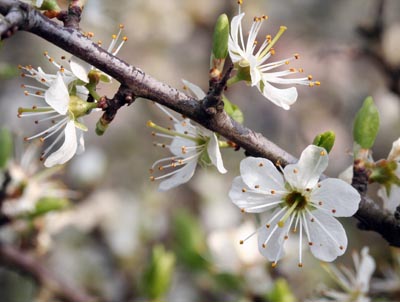
 And everyone is talking about the Blackthorn flowers this year. The show is quite stunning:

Blackthorn Flowers

April 28th is St. Mark's day, and the Bibio genus of flies appears on or around that date, so they are commonly known as St. Marks Flies. With this being such an early year, they are a couple of weeks earlier than usual:
Male St. Marks Fly
The large black flies that you will currently see flying with their hind legs dangling down is another, larger, species of Bibio.

 Tomorrow I'm off to a limestone area, so I should find something interesting there.

Sunday, 17 April 2011

Little differences

Our native butterflies appear in a rather strict sequence depending on whether they overwinter as adults (e.g. Small Tortoiseshell) or as pupae (e.g.Green-veined White), below:
Green-veined White butterfly
This close-up shows that the 'green' veins are actually made up of  minute yellow and black scales under the wings:
Green-veined White closeup
Male Orange Tip butterflies are also out now, in tight synchronisation with their host plant, Cardamine pratensis.  They are patrolling hedgerows at the moment, establishing their territories, and the females will emerge in the next week or so.

If butterflies and moths are around, then their deadly enemy the Tachinid fly is bound to be around, too:
Tachinid Fly
These are parasitic on the larvae of numerous insects, laying their eggs either near the larvae (so they can be accidentally eaten by them) or directly onto them. They then live internally in the larvae, consuming fat reserves and other non-essential parts before emerging to pupate themselves. In field tests around 80% of butterfly and moth caterpillars are found to be parasitised. Tachinids can be differentiated from other larger flies by the long spines and bristles that cover all parts of their body.

Germander Speedwell is opening up all along the hedgerow:

Germander Speedwell

If you're ever in any doubt about a Germander identification, check the stalks. If they have a pair of rows of hairs, then your identification is secure:

Germander Speedwell stalk, showing the twin rows of hairs

Sawflies are a very under-documented part of the bee and wasp family. They take their name from the female's modified stinger, which takes the form of a saw which is used to cut slots in leaves. She then lays eggs in the slots and they hatch out into larvae that very closely resemble the caterpillars of moths and butterflies. Sawflies can be tricky to identify, but if you see a v-shaped suture on the thorax, then you can be pretty sure it's a sawfly.
Adult Sawfly

I checked the lights last night for moths, but it was raining, so there were no moths around. I did, however, spot this snail crossing the step:

Wednesday, 13 April 2011

Early year?

I'm hearing many reports of species being 'early' this year. Species have been appearing at earlier and earlier dates over the past few years; so much so that it has almost become the accepted norm and people don't even mention it any more. But this year I'm again noticing that more people are making special mention of early specimens of moths, butterflies and other insects, so perhaps things are particularly early this year.

The following shot certainly illustrates that trend as far as I'm concerned, but before I discuss it, what type of insect do you think the following picture shows? (bumblebee, wasp, fly, other?):


Male Eristalis intricarius
Well, to put you out of your misery, it's a hoverfly: a male Eristalis intricarius. These are good bumblebee mimics, and at first glance, when they're stationary, they are easily mistaken for Bombus lucorum.

A few identification pointers might help. Firstly, it has only two wings; flies have two wings, bees have four. Secondly, the head is almost completely made up of eyes. In a bee, the eyes are long and narrow, with visible parts of the 'face' on both sides of the eyes. (Incidentally, the fact that the eyes meet in the middle is what makes it so clearly a male). Thirdly, what appears to be an orange stripe between the wings is actually the shiny scutellum, and isn't really a stripe at all. Finally, if you look carefully at the wing veins, you can clearly see the famous 'Eristalis bulge', which is unique to the Eristalis group of hoverflies:

Eristalis 'bulge'
The shot also illustrates another of the wing features which identify hoverflies: the 'False margin':


The trailing edge of the wing is not constrained by a vein: it is free to flex as the wing moves. I rather suspect this is one of the main reasons why a hoverfly can hover so accurately.

In terms of earliness, I have only once seen Eristalis intricarius before June: I have come to regard it as a summer species. The references say from March, but that would probably be a date from much further south.

The next shot shows a couple of tiny flies (on Dandelion for scale). On the left is a Sepsid fly: these run around on leaves and flowers with their wings flapping up and down in a semaphore fashion. On the right is one of our smallest hoverflies, Neoascia podagrica:

Sepsid (L) and Neoascia podagrica (R)

Here's a close-up of the (8mm. long, female) hoverfly:


This is again much earlier than I would normally expect to see it.

In terms of grasses, the first to flower around here is usually Sweet Vernal Grass, but that hasn't appeared yet.  Instead, I found Meadow Foxtail:

Meadow Foxtail
I have included a little insert (top left) showing the very short 'ligule' which can be used to assist with identification.

Sunday, 10 April 2011

Recolonisation

The area I went to today was Spruce plantation for 50 years, then it was clear-felled about 10 years ago.  The original heath environment has recovered somewhat, leading to a wide diversity of wildlife where there was nothing but a black, arid desert for 50 years.

The area is rich in lichens, mosses and heathers, and the remaining stumps and logs are home to more lichens, fungi and insects.

Bilberry is just flowering now, and this flower has drops of what I presume is nectar forming on the inside:

Bilberry flower
Racomitrium mosses have a very distinctive appearance: each leaf ends in a long, twisted hair that gives the plant an overall pale colouring.

Racomitrium lanuginosum
Peltigera lichens are very leafy in appearance, although their colouring ranges from black to palest grey. This huge (40 cm.) specimen of Rabbit's Paw lichen -Peltigera membranacea - is growing on a dead log. 


Here's a close-up of one or two of the individual 'leaves' (properly called 'thalli'):

Peltigera membranacea
Equisetums (popularly known as Horsetails) are some of our most ancient plants. This immediate area has three species in very close proximity, although I do know of a nearby area with Wood Horsetail which clings onto remnants of its original woodland habitat (which presumably preceded the Spruce plantation).

Marsh Horsetail tends to grow in the fringes of wet areas:

Marsh Horsetail

Whilst Water Horsetail definitely prefers its feet to be very wet:

Water Horsetail

Field Horsetail has separate, pale, fruiting growths, which precede the green non-reproductive shoots:

Field Horsetail

Horsetails reproduce via spores which have hair-like growths attached to them. These hairs are very sensitive to humidity and they expand and contract very rapidly, enabling the spores to move through the undergrowth as if they were walking. 

This next shot is rather interesting:
Bombus bohemicus

It's Bombus bohemicus, one of the parasitic Cuckoo Bumblebees. Bombus bohemicus is parasitic on the white-tailed Bombus lucorum complex and, yet again, timing is critical here. The queen of the host species finds a place for her nest and lays her first batch of worker eggs. The cuckoo bumblebee then invades the nest and kills the original queen before laying her own eggs. The host workers then proceed to feed the cuckoo bees for the rest of the season. I watched this cuckoo bumblebee feeding on nectar and then it proceeded to remove all traces of pollen from its legs (you can see the pollen on the grass in the picture.) Since one of the primary roles that bumblebees perform is pollination, it's clear that adult cuckoo bumblebees are of no benefit to either plants or their hosts.


Another legacy of the original woodland environment is the occasional specimen of Wood Sorrel:
Wood Sorrel
Micromoths are just beginning to make their appearance for the year. This is Grapholita jungiella:

The micromoth Grapholita jungiella
These micros are very active at the moment, and you usually have to be patient enough to follow their very erratic flight in order to see them at rest after they eventually land. 

Tuesday, 5 April 2011

Gap in the rain

Normal service has been resumed after wonderful weather in March, and I have been sitting (no, standing!) glowering at the rain for the last few days. I spotted a short burst of sun, so I rushed off to the most likely spot for a few moments.

The patches of Celandines are all fully open in the middle of the day, so the insects were making the use of the gap in the weather, too. The following shots of hoverflies illustrate some of the difficulties we have in making accurate identifications.

This is a male (eyes meet in the middle) Melanostoma species:

Male Melanostoma mellinum on Celandine
The (relatively) short abdomen leads me to Melanostoma mellinum, because the alternative, which is Melanostoma scalare, has a much longer abdomen in the male.

Notice the very slender front feet.

Next we have a male Platychierus sp. (notice that the front feet are much wider and longer than those of the Melanostoma). The legs also appear to be more robust than those of the Melanostoma.

Male Platychierus sp.
If I was a gambler, I'd say Platychierus albimanus, but I'd like a look at the abdominal stripes before committing.

The next is quite a different beast altogether. It's a female (eyes don't meet in the middle) Cheilosia sp. Cheilosias are darker, chunkier and larger than the two previous families, and although it's difficult to detect from this shot, the wings have a bronze tint to them. Other shots leave me quite convinced that it's Cheilosia albitarsis, and the size is ok for that, too. 

Female Cheilosia sp.

This male Eristalis pertinax was basking on a Buttercup leaf:
Male Eristalis pertinax
Given the absolutely pristine condition (clean feet, shiny wings, clean hair, no pollen), and the fact that the wings look a very little on the small side, I'd say this had just emerged and the wings still have to finish inflating.

And this is also an emerging specimen: the first Common Carder Bumblebee - Bombus pascuorum - of the year. This has to be a queen, although these are much smaller than the queens of the darker bumblebees that we have around here.
Emerging Bombus pascuorum queen
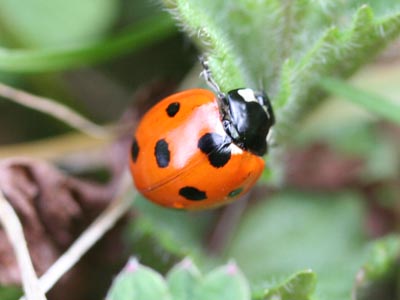
This 7-spot Ladybird was running around leaves and flowerheads looking for aphids. Given the speed of the chase, this was a very difficult shot. No time for basking in this case:
7-spot Ladybird

It's really full speed ahead on all fronts at the moment. This Common Dog Violet - Viola canina - is also just opening: the petals still have to rotate to their final positions.

Viola canina
I've included a side shot to show the pale, notched, spur that identifies this species:


Hartstongue fern is usually the first to unravel. I have 15 or 16 different species of ferns on this stretch, so we should be able to follow the sequence of these as they open up:


Not bad for about 10 -15 minutes.

Monday, 28 March 2011

Lovely weather

Most of the flowering plants are working to the normal schedule: the cold winter appears to have had little or no negative effect. Primroses have opened up all along the verge and ditch edges:

Primrose
The Barren Strawberry can be separated from the wild strawberry by the notch in the outer edge of the petals and also by the slightly glaucus appearance of the leaves:

Cow Parsley is beginning to show faster growth now, and already the fungal rust Puccinia chaerophylli is in evidence.

Puccinia chaerophylli on Cow Parsley

References say May-June, although I have found it in mid-April. I'm beginning to wonder if this is going to be an 'early year'.

Most of the early moths are showing up now:

Early Grey - a Willow pollen feeder

Early Thorn, found on many broad-leaf woody plants

Twin-spotted Quaker - another Willow feeder

Hebrew Character - one of our most widely-spread moths. Eats many plants.

Caddis flies are often mistaken for moths, but the wings are downy rather than scaled and the antennae are held in a forward-pointing position.

This specimen appears to be one of the Anabolea family, but it could be one of 25 different species.


Caddis fly larvae are usually aquatic and live in cases made from debris glued together and rolled into a tube.

Tuesday, 22 March 2011

Keep learning

Over the years, as experience builds up, you make a series of 'rules' which help you reach an identification. Until yesterday, one of my rules was "If you see a bee which is less than 20mm long, then it isn't one of the social bees". Applying this rule, I leaned towards one of the Andrena solitary bees for this specimen: 


But it didn't match any of the images that I could find in the usual places. When I asked for help, back came "It's a Honeybee". Blinded by assumption (and not helped by the fact that this was roughly 60% - 70% as big as I would normally see), I had excluded the obvious. Factor in the fact that Honeybees have become very rare in our area, and the mistake is easy to make.

Assume nothing.

Moving swiftly on......

This Eristalis tenax hoverfly has the very dark colouring that we expect to see in early specimens. The summer generation of many of our hoverflies is much brighter due to the higher temperatures. This female will have mated at the end of last year and has managed to successfully shelter in some nook or cranny through the -17 degrees that we endured in December:

Female Eristalis tenax
The Willow catkins opened last Thursday (17th) and insects have been busy nectaring and gathering pollen ever since. This queen Bombus lucorum bumblebee found the pollen quickly enough:

Queen Bombus lucorum
She is now gathering enough pollen to feed the first few workers from her nest, and she will spend the rest of the year laying more eggs to sustain the nest and produce drones and queens for next year's generation. A few of the new queens actually become workers for a while at the end of the season, gathering pollen alongside the last of the workers.

With the early willow pollen season being so short, no time is wasted before the willow-dependent moths appear. This is the first Common Quaker - Orthosia cerasi - of the year:

Common Quaker - Orthosia cerasi
The Common Quaker is readily identified by the large, rounded, 'kidney mark' which has a pale, thin, outline which matches the colour of the thick band near the trailing edge of the wing.