Friday, 29 November 2013

Raindrops keep falling on my head

It seems that we have had rain pretty constantly for the past two months, although I know we did actually have one or two dryish days. Interestingly enough, when it's raining you can't get those attractive shots with water droplets on mosses and other things: it's too wet. But when the rain drops to a drizzle or mist, then we can get those eye-catching shots where the water is just gathering, but isn't getting blasted off by new raindrops all the time. Yesterday was one of those days.

Woody Nightshade, or Bittersweet, is a member of the Solanum family, which includes tomatoes, potatoes and aubergines (and these are all closely related to tobacco, peppers and petunias, amongst others).

Woody Nightshade - Solanum dulcamara
I had always associated the Solanum family with the Americas, since that's where tomatoes, potatoes and tobacco came from, but I note from the references that Solanum dulcamara is documented as a native. This jarred with me a bit, as another interest of mine is the origin of national cuisines: try imagining Italian food without tomatoes or Indian without chillies. So I began to wonder whether the diversity of all those foodstuffs in one place was a series of genetic flukes or the interference of the human hand. It turns out that the Solanum family is very widespread, but is most diverse in south and central americas. Add in the fact that the americas were effectively isolated from world trade routes until the 16th century, and it is quite possible that this family of plants, possibly aided by congenial weather and geography, diversified with some human assistance in glorious isolation until the european trade built up.

Did anyone notice the fly on the droplet under the fruit furthest on the left?

Ivy-leaved Toadflax grows on most of the old walls around here, and can be seen in flower all year round:

Ivy-leaved Toadflax

Mosses are always good for droplet shots, and a particular fencepost is always fruitful. This specimen of Tortula muralis sports two distinct sets of droplets: one on the capsule-bearing setae and the other set on the much lower leaves.

Droplets on the moss Tortula muralis

Another angle and specimen brought up this shot of two capsules with a suspended piece of spider's web between them:

Tortula muralis with spider's web droplets
Ivy is a major source of late nectar for insects, and the overall flower display seems to last a couple of months, although individual flowers are very short-lived:

Ivy flowers
The five-sided fruit are starting to show now:
Ivy fruit

Tuesday, 26 November 2013

Identifications and recording

Whilst many of our species can easily be identified on sight, a far greater number require more detailed analysis. This analysis takes many forms, and can vary from measurements, counting features, rearing/breeding, chemical reactions and microscopic analysis through to dissection. Many of the features can be microscopic, which will require a specimen to be collected, captured or perhaps killed.

Identifications can be performed at varying levels of abstraction e.g. to family or genus, or carried out to the precise species (or subspecies!). In order to arrive at a species identification, we usually rely on keys. Keys are constructed in different ways, but the principle is always the same: by comparing features in a systematic way, and taking different routes through the key depending on analysed features, we arrive at an identification.

Once we have a tentative identification, we must then look at the species description to confirm that details such as geographic distribution, phenology (timing and location), host(s) and habitat match to a reasonable extent. If some features do not match well (for example your specimen is many hundreds of miles from the nearest previous sighting) then further assistance will need to be sought from more experienced person(s). If none of the details match, then the identification is probably wrong and the specimen should be taken through the key(s) again.

Identification keys are like gold dust to naturalists: many are out of print, so we need to seek rare (and frequently expensive) books or to find a source of 'draft keys' which are sometimes circulated for comment/testing/approval.

A further complication is that some keys only identify to an abstract level such as family or genus, so we need additional keys to get our specimen to species. These books are often written by different authors at different dates, so terminology can vary. This means that we might need to learn the specific terminology used in different parts of the key, leading to the need for a glossary for each book. So already we can see that some identifications will require at least four books and a microscope (or two) to be in use at the same time. Some keys run to hundreds or even thousands of pages.

Some keys work at the local level (usually country), but some are aggregated across countries (e.g. Northern Europe) and can be written in different languages. So we might also need a dictionary or two. One serious drawback of the multi-national identifications is that they will probably include species not (yet!) found in our own country, so we will also need access to country checklists for the family we are considering. This will give further assistance when considering tentative identifications, but are also useful when identifying a 'country first'.

Finally, ongoing research and changing phenology due, in part, to global warming can mean that we are working with a moving target with new species to consider in our task. Some of this changing work has not yet reached the books, so we need access to articles and papers in various publications in order to keep up to date.

Most people nowadays specialise in a small number of groups, so need only a restricted amount of relevant documentation, but others, like myself, are 'pan-species listers' (generalists) so we need a library that grows exponentially over time. The main benefits of being a generalist, however, are the ability to see across groups and to have a good overall picture of what's going on.

Records are a formal way of documenting where and when a specimen has been found. The minimum information for a record is species name, location name, date, grid reference and name of person making the record. Additional features will be required for different groups. e.g. host plant for fungal rusts, miners and parasites, lifecycle stage for moths, butterflies and other insects, substrate for lichens and mosses. Most recording schemes have a specific recording format that needs to be completed when submitting records for that group, and this will specify any additional data fields that are required.. Records are compiled by 'recorders', who generally work at the vice-county level, although some will work at county or even country level. Recorders are ideally people who are experts in their particular group(s) and will have a methodical way of compiling/aggregating and validating their records. Some records, especially county firsts or country firsts, will usually expect to be accompanied by a specimen. These records are eventually filtered up to the national records database for their particular country. Specimens for country firsts are often curated in national museums.

National records databases are a vital source of information on movements of species (spread, new arrivals or departures) and can be used to detect areas requiring further analysis or assistance. Various initiatives are used to stimulate the flow of records, including bioblitzes and school projects.

I have submitted a (rather late) record for this Common Wasp - Vespula vulgaris - that I found wandering on an indoors window at the weekend:

Vespula vulgaris

Vespula vulgaris - face
This very fresh (shiny carapace with long hairs still in place) worker had emerged very late in the year, long after the nest would have been abandoned. Note that the face is very round, ignoring the jaws: this is a key feature which separates the Vespula genus from the Dolichovespula genus. In Dolichovespula species, the gap between the bottom of the eye and the top of the jaw (the 'malar space') is much larger, leading to a vertically oval, or long,  face. Here's an archive (2010) shot of a male Dolichovespula norwegicus to illustrate the difference:
Dolichovespula norwegica, showing the larger 'malar space'

Wednesday, 6 November 2013

7 year identification

On 11th October 2006, I published photographs of an unknown Chalcid wasp ovipositing into galls of Neuroterus numismalis, a Cynipid wasp that creates galls on oak leaves. In common with many Cynipid wasps, the life-cycle of Neuroterus numismalis is complex, with different generations making different galls on oak leaves. The autumn generation creates doughnut-shaped disks, variously called 'Silk Button' or 'Spangle gall' on the underside of the leaf. These disks are the home and food for the larva of N. numismalis, and they eventually drop off and overwinter on the ground.

Galls are frequently visited by other wasps for a number of reasons: they contain food and at least one larva which, itself, can be food or a host for a parasite's egg. Some wasps treat the gall as a home for their own larva, which will coexist with the host. These are known as 'inquilines', and are harmless to the creator of the original gall. Different parasitic wasps can target either the original larva or any inquilines which may be present.

Here's the original shot of the egg-laying process from 2006:


Chalcid wasp ovipositing
And here's a shot that shows the scale of the whole event:

Oak leaf, showing galls and wasp
The Chalcid is the dark mark which can be seen to the left of the pair of galls at the lower left. The galls are 3 mm. in diameter, so the wasp is around 2 mm. in length.

The identification literature on Chalcids has been out of print for some years, and has been very difficult to obtain, so for 7 years I have had to put this down as 'a Chalcid Wasp'. Since we have been in a phase of perma-rain for almost a month, I have had plenty of time to carry out background research, and I finally managed to get a copy of parts a and b of volume 8 of the RES guides:


This was originally published in 1958 (almost half a century ago!) and contains keys and descriptions of 1400+ species of UK Chalcids known at that time, along with a cross-reference showing the target host(s) of each species, if known.

The keys depend on microscopic characters, which always require a specimen and a microscope, so I couldn't key out my specimen from my photographs. The cross-reference, however, showed only three species that specifically target Neuroterus numismalis, so that narrowed things down a bit. Two of the species could quickly be eliminated due to gross features - such as colour - leaving me with Cirrospilus diallus as the only viable option. The description for Cirrospilus diallus fits what can be seen from my photographs and also mentions that it's the most common species of Chalcid in Oak woodlands, so it doesn't seem too unlikely.

Since I haven't keyed out the specimen from first principles, this can't be seen as a definitive identification, but it's not entirely impossible. There is one previous record from Ireland: from county Kildare in 1946. This record was made on the 13th October, which also neatly ties in with the date of my specimen.  


Tuesday, 22 October 2013

Update to Interference Patterns (1st October)

A couple of weeks ago, I posted about the braconid wasp Apanteles glomeratus, which is parasitic on the Large White butterfly. At that time I mentioned that I had taken a sample batch of the parasite cocoons, and yesterday I noticed that the petri dish was full of minute wasps. I popped one under the microscope:

The braconid wasp Apanteles glomeratus - adult
I appear to have both males and females, although the females are more numerous, as you might expect (female Ichneumonids are usually self-fertile). Both measure 3mm long, excluding antennae. There are 32 in the sample. 

So we have a few interesting numbers resulting from this sample:

  • Pupation period of the wasp is around 21 days.
  • One fully-grown larva of the Large White can support 32 wasp larvae.
  • A few of the wasp cocoons have not (yet) hatched. Perhaps these are parasitised and will emerge later.

I was a bit surprised that they emerged so quickly, since there are very few Large White larvae around at this time of year, so I presume they must overwinter a hibernators, ready to restart the parasitization cycle when the first batch of Large White larvae hatch next year. 

Documentation of these observations seems quite scarce, and I have communicated the sightings to the appropriate people.


Wednesday, 16 October 2013

Bioblitz at Cultra

The final bioblitz of the year was held in the grounds of the Ulster Transport Museum in Cultra. It's quite late in the year, but plants and fungi were still around in good numbers. The area is largely parkland, with mature woodland patches and fringes. Many of the trees and plants are clearly introduced, but there are good stands of Oak, Birch, Beech and other species that support various fungi. I was mainly recording leafminers and fungi, but I added a few interesting plants, too, including a single specimen of Epipactis helleborine which is quite scarce. One new plant for me was the introduced Pheasant Berry, which was heavily infested with mines. The mines seemed familiar, and when I got back to the office and on to the internet, I found that it shares the same miners as Honeysuckle.

One of the first fungi I found was Cortinarius hemitrichus:

Cortinarius hemitrichus
I don't usually try to identify Cortinarius to species, but there are only a few grey ones, and the description of the stipe: 'scurvy white below the cortina (ring), but plain white above it' fits very well.

New to my Species Index.

Another new species for me is the very distinctive Chroogomphus rutilus:

Chroogomphus rutilus
I found this quite early on, so I had a chance to make a spore print during the day. The spores are dark purple, almost black and these, along with the deeply decurrent gills, quickly led to the identification. These were rather numerous under conifers. Quite a handsome beast.

New to my Species Index.

One very distinctive species was found in a number of places, especially under Birch: its normal associate:

Amanita muscaria - Fly Agaric
I found this batch growing in a lawn under a large Fir, hundreds of yards away from any Birch specimen, and I have occasionally found A. muscaria under other conifers with no sign of Birch anywhere nearby. I can only assume that there's some old remnant of a birch root still in place under the ground many years after the tree has died or been removed.

One of the great things about bioblitzes is that you have the opportunity to meet people who specialise in different areas, so you're always finding out something new. One of the recorders was targeting spiders and harvestmen and he showed me this specimen of the harvestman Paroligolophus agrestis:
The harvestman Paroligolophus agrestis
That shot quite neatly shows the difference between harvestmen and spiders: harvestmen have a body formed from a single oval, without a waist.

I think I feel a book on spiders and harvestmen coming on.....

Tuesday, 1 October 2013

Interference patterns

One thing that I'm constantly aware of is the dramatic impact that we humans have on the wildlife that surrounds us. We cut (thrash!) hedges in summer, remove hedgerows (only to replace them with a nice fence), spray with insecticides, let our cats wander freely to bring home kills, scrape lichens off trees. And then we wonder where our wildlife is disappearing to. I like to think that I help a little by keeping some wild patches on my land, and I spend a lot of time in schools, spreading the benefits of wildlife and conservation to as many people as possible. But this year I have (albeit unwittingly) tilted the balance very much in favour of some of our local wildlife.

For many years, the Large White and Small White butterflies were not recorded in my 10k square. There are a few reasons for that, but one of the main causes is that people have stopped growing brassicas in their gardens, so the opportunity for the larvae to feed has been removed. A couple of years ago, I started a vegetable plot, but yields were bad due to very wet summers. I did notice a few Large and Small Whites, though. This year, the weather in July was superb, and the vegetable garden grew like crazy, with large leafy growth of cabbages, broccoli and cauliflower. I noticed a few eggs of Large White and watched a few of them eating some leaves at the edge of the patch, so I left them to it. September was a bit damp, so I didn't spend much time in the vegetable plot for a couple of weeks. Last week I went out to find that entire rows had been eaten back to the stalks, with dozens (maybe hundreds) of larvae on each skeletal plant, and in all stages of development from eggs to fully-grown. This is the time of year when many caterpillars seek somewhere sheltered to pupate, and the walls, windows and doors of my house are a local and acceptable place for just that purpose: this weekend, I found dozens of Large White caterpillars all round the house.


Larva of Large White butterfly ready to pupate
Having observed a large number of specimens, it seems that they choose a spot for pupation and then stay motionless for around three days before shedding their skin and making a chrysalis. I suppose this three day period is the time when the internal changes are taking place.

Successful larvae end up in a chrysalis which is usually fixed at the tail end, hanging in a head-down position:

Chrysalis of Small Tortoiseshell butterfly
I have these dangling from doors, windows, gutters, soffits and facings.

All is not rosy for some of the caterpillars, though. Large Whites have a parasitoid which is unique to them: the Braconid wasp Apanteles glomeratus. Most parasitoid wasps lay a single egg in the host's body, but Apanteles glomeratus is very small and lays many eggs inside the 1st instar caterpillar. While the caterpillar is growing, the parasitoid larvae eat the fat stores in the caterpillar, leaving all the working parts untouched. When the caterpillar has reach its final position but before it pupates, the parasitoid larvae burst out through the skin all at once:

Larvae of the Braconid wasp Apanteles glomeratus emerging from a Large White butterfly caterpillar
After a day or two, the skin blows away and we are left with a stack of pupae of the wasp:

Pupae of the wasp Apanteles glomeratus

I estimate that there are 50 - 60 pupae in that stack.

I did a rough count of pupae vs. chrysalis and I reckon 30% of caterpillars are parasitised in my sample.

Now all I have to do is keep watching those stacks to see if a hyperparasite turns up.

A completely unrelated caterpillar walked across my field of view as I was watching the Large White larvae. This is the caterpillar of the Bright-line Brown-eye moth:

Larva of Bright-line Brown-eye moth

It's interesting that the common names for moths seem to have been chosen in many different ways. I suppose early identifiers/classification experts were just as confused as we are today about which species were which, and clung to almost any clues they could get. I have identified at least:


  • Habitat (e.g. Latticed Heath)
  • Adult pattern (Broken-barred Carpet)
  • Adult colours (Red/Green Carpet)
  • Larval pattern (as in this case)
  • Name of finder/identifier (Svensson's Copper Underwing)
  • Food plant (Foxglove Pug)
  • Whimsy (Cousin German) 
  • Adult season (November Moth)
  • Indecision (Uncertain)


And some I can only guess at (Vapourer).

Late update: of the most recent Large White caterpillars that I have observed to attempt pupation, 100% have been parasitised. That brings the overall total to around 80%, which is the usually-quoted percentage. A few things come to mind:

The Large White is almost continuously-brooded, since I have seen caterpillars of almost all sizes simultaneously. The parasitoid is known to be present from spring onwards, but it seems like my later caterpillars have been parasitised the most. It is also known that the parasitoid injects all of its eggs in a single injection, so it is clear that the parasitisation occurs very briefly. Perhaps the parasitoids come through in 'waves'.

I am now collecting parasitoid pupae to see how many of them have been parasitised.


Saturday, 28 September 2013

More from Banagher Glen

When I'm looking at leaves for rusts and other fungi I often come across caterpillars of moths, especially at this time of year when larvae are fully-grown and are looking for somewhere to pupate and overwinter.

This larva of the Coxcomb Prominent moth adopted a defensive posture by throwing its head backwards, using its legs to make it look spiky.

Larva of the Coxcomb Prominent moth
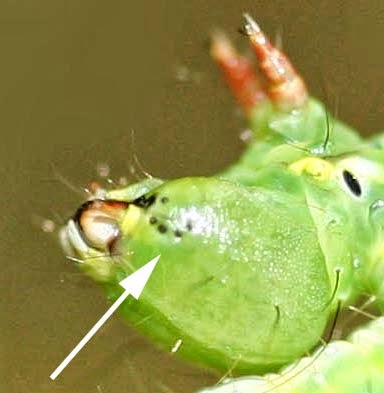
Just as I was writing this, I spotted that this photograph shows an important feature to aid identifications. The larva has a number of ocelli - simple eyes - arranged in a curve. If there is any doubt about whether you are looking at a caterpillar or a sawfly larva, then this is an important distinction: the larvae of sawflies have only a single ocellus.

Ocelli of Coxcomb moth larva
Here's an old image of a sawfly larva, showing the single ocellus:

Sawfly larva showing single ocellus
(That image shows how things have moved on in eight years; I used to think my photos were good in those days!)

We found another larva on Birch:

Larva of  Light Emerald moth
Seems to be the Light Emerald moth, which overwinter as larvae.

New to my Species Index.

Leaf mines are also maturing at this time of year. This is the fly Phytomyza tussilaginis:
Mines of Phytomyza tussilaginis on Coltsfoot
New to my Species Index.

And another new species for me: 

Mines of the micromoth Phyllonorycter nicellii on Hazel
New to my Species Index.