Tuesday, 13 July 2010

Angelica est arrivé

The annual opening of the Angelica is a time to rejoice: the readily-available nectar is a major food resource for many insects, especially those with shorter tongues. Over the next few weeks I expect to photograph bees, wasps, ichneumonids, Ectemnius wasps, moths, beetles, sawflies and butterflies, many of them sharing the large flowerheads. This is a close-up of the social wasp Dolichovespula norwegica, which builds its nest in trees:

Dolichovespula sp. wasps appear to have a 'long face', which can be readily confirmed by the gap between the eye and the jaw.

Episyrphus balteatus is one of the more recognisable hoverflies, due to the unique 'twin-bar' marks on the abdomen:

Having recently shown the White Plume moth, it's nice to show the much more common Emmelina monodactyla plume for comparison:
(These also feed on Convolvulus sp. bindweed)

Family associations are a feature today. This is Udea lutealis, a very common relative of the Udea olivalis micromoth that I showed the other day:

I always think that ferns make an excellent background for insect photos.

Saturday, 10 July 2010

Moths galore

One of the most common caterpillars on my patch is the Garden Tiger moth: they're all over the higher-level plants. This is the first time I've seen the wonderful adult, however:


The white plume moth is the White Plume Moth - Pterophorus pentadactyla, which feeds on Convolvulus (and is one of the few micromoths with a common name). This is another first for me:

And another new first for me is the Satin Beauty - Deileptenia ribeata, which feeds on Norway Spruce. Unsurprisingly, this is an increasing species:
Just for the record, a July Highflyer:

And to finish off for today, my favourite flower, Slender St. John's Wort:


Friday, 9 July 2010

And still they come

I was walking along the hedgerow and suddenly got an irresistible urge to look at the underside of some Lady Fern. I spotted some dark objects at the limit of my unaided vision and fired off a few shots. The result? Two new species and some serious eye-strain.

The two mirid bugs (collectively called Fern bugs) that follow both feed on the spores and sporangia of ferns. First is Monalocoris filicis, about 2-3 mm. long:

(Note the 'missing' sporangia on the above frond.)


And the second is Bryocoris pteridis:


As a bonus, I found that I had incidentally photographed the nymph of Monalocoris filicis on the same frond as the Bryocoris:

The main identifying feature between the two mirids is the length of the first antennal segment, which is less than the width of the head in the Monalocoris and as wide as the head in the Bryocoris. Head colour is also different.

I'm not sure what the precise habitat requirement is for Eyebright, but I only ever find it on woodland paths:
The flower is very much like an orchid, with very clear nectar guides and carefully-positioned pollinia. When you consider that bees and flies see in the UV spectrum, those guides must be like large flashing neon signs...."Come and dine here!".

Some of the Phyllonorycter micromoths have taken leaf-mining to a new level: they mine out a section of leaf and then make creases in its lower surface. As the leaf continues to grow and the creases deepen, the upper surface of the leaf buckles upwards, making a fine tent for the larva to feed and develop inside. This enables it to reach a larger size than would be possible if the space was limited by the thickness of the leaf. The following shot shows the underside of an early mine of Phyllonorycter maestingella on Beech:

Two moths which illustrate one of the difficulties of moth identification came to light: first Udea olivalis, which feeds on bushes and shrubs and is a micromoth:

And Small Fan Foot, which is a macromoth:
These moths are roughly the same size (about 15 mm. long), but they are found in different reference manuals. So unless you know which group they belong to, you don't know which book to consult. But if you can't identify them, then you need to look them up.....

Thursday, 8 July 2010

As promised

The Buff Tip moth has a great camouflage system which is composed of a number of parts: Firstly, the rear of the front wing has an oval mark that resembles a twig broken at an angle. Secondly, the thorax looks like the end of a twig that has been snapped straight off. Lastly, the thorax can be pulled into the ruff of hairs that make a collar just behind it. When the thorax is tucked away in this manner, the head points downwards and the eyes are hidden away down near the feet, as shown below:

I updated my species list during the rather frequent rain we've been having.

Sunday, 4 July 2010

Calm before the storm

Sometimes art and science come together. This shot of an Ichneumonid on Cleavers has a very pleasant symmetry:


As I was selecting the shots, I found this one with two minute Ichneumonids, which I estimate were between one and two millimetres long. Notice the transparent 'hooks' which give the plant its 'stickiness':

Liriomyza congesta is a new-to-me leaf-mining fly which mines various members of the Pea family. I found it on Meadow Vetchling:

The diagnostic features of this mine are the green frass with black dots.

As if we needed confirmation that we are heading nose-first into the darkest depths of winter, I found my first specimen of Rhagonycha fulva for this year. These usually emerge after June 21st., when the larger Umbellifers (Hogweed, Angelica....) are starting to flower.


And this closely-related (but very much smaller....6mm.) member of the Soldier Beetle family is also new to me. It looks closest to Malthodes mysticus:


This handsome-looking chap is one of the Tetanocera, or Snail-killing flies. These lay their eggs close to snails, which then eat the eggs. The larvae then hatch and consume and kill the snail:


Snipe flies are fearsome predators, taking other insects in mid-air:


The micromoth Celypha lacunana is around in huge numbers at the moment:


The other day, I showed the Buff Tip moth taken at night with flash. Here's a daytime shot:

Friday, 2 July 2010

Bang on time

I was thinking it was time to see the summer butterflies and, sure enough, I found Meadow Brown, Ringlet, 2nd generation Speckled Wood and 2nd generation Green-veined White all within a minute of each other.

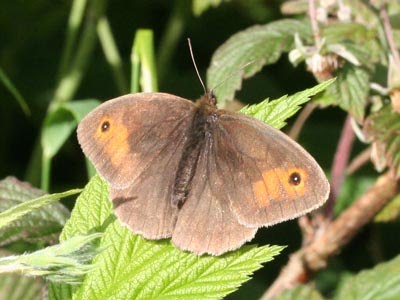
The Meadow Brown is a grass feeder, but it frequently basks on higher plants:


The Ringlet is also a grass feeder. This shot shows where it gets its name from:

That brings the number of butterfly species on this short (80 m.) section of hedgerow to 7 for this year:

  • Green-veined White
  • Speckled Wood
  • Orange Tip
  • Small Copper
  • Meadow Brown
  • Ringlet
  • Small Heath

There's still time for Small Tortoiseshell, Peacock, Painted Lady and Red Admiral, all of which have been spotted here before. Green Hairstreak is also a slight possibility.

I have found this Bramble-eating sawfly larva for a couple of years, now. I'm still working on an id:

The first of the Ichneumonids with the longer ovipositors have started to appear. These lay eggs into moth or fly larvae in grass seedheads or in composite flowerheads such as Thistle or Knapweed. They tend to feed for a couple of days before I see them laying, so I expect to get some oviposition shots by next week. The very long rear legs on this one suggest something close to Lissonota sp., which use the long legs to keep the abdomen clear of the seedhead when swinging the ovipositor into position on grasses.


Wednesday, 30 June 2010

Still more new

The Buff Tip moth - Phalera bucephala - is instantly recognisable due to its astonishing similarity to a snapped twig. I hadn't seen it in the flesh, although I recognised it quickly enough. It's new to me, as are the next four species. The high number of new species I'm finding at the moment is almost certainly due to the excellent spell of hot weather which is encouraging insects to stay in the open longer.


This is one of the Stilt Flies, so-called due to the long legs. The head is almost completely composed of two large eyes, which aids the hunt for other insect prey. Neria cibaria:


Since I recorded my first new species for Ireland in 2004, I've continued to add a couple of new species each year. Most of those are new records simply because nobody else had been looking closely enough, but some are genuine rarities. This leaf-mining fly - Agromyza ranunculivora - which mines Creeping Buttercup, seems to be a first record for Ireland, and the NBN gateway only shows a couple of records in England. Certainly the standard reference for leaf-miners didn't have an image. It does now.


This tiny (5mm) Capsid bug is quite common, but it's still the first time I've seen it. It's Capsus ater, and is associated with various grasses:


At first glance, this hoverfly might seem to be one of the very common Eristalis species, but a second glance shows the yellow hairs, a wing shade and extra small spots of yellow on the abdomen. That makes it Eristalis horticola which is widespread but never numerous. This is the third or fourth specimen that I've seen:

Many of the Sepsid flies have a single spot on the wing, and they run around the top of leaves waving their wings in some sort of semaphore signalling system. They're always on the go, so they're very difficult to photograph. Same size as an ant: