Showing posts with label Peacock. Show all posts

Friday, 2 October 2015

Sun!

Our summer has been one long stream of anticyclones coming in over the Atlantic, bringing high winds and rain for almost four months. As a result, flying insects have been far less frequent than usual, with hedgerows and verges almost deserted for much of the year. Flowering plants don't seem to suffer quite as much, but perhaps the number of blossoms is down.

Late September and early October have seen the arrival of a high-pressure system that has 'stuck' in place over the UK and Ireland, bringing dry days and colder nights. The circulating wind has brought warm southerly air to Ireland, leading to an influx of European species to supplement the meagre numbers of locals. At one point last week I had 7 specimens of Silver Y moth in my greenhouse.

By a strange coincidence, this is the time of year for the second generation some of our native butterflies to emerge and prepare for hibernation. A large Sunflower which I grew this year has been very attractive to Small Tortoiseshell and Peacock butterflies:

Small Tortoiseshell

Peacock
These will hibernate until March or April next year, when they will emerge to lay eggs, and the first 2016 generation will start. Both of these species use Nettles as their sole foodplant.

This is the first year for my new greenhouse and I tried different plants to see how they got on. I noticed after a while that pollination was largely being performed by a single male Episyrphus balteatus hoverfly:

Male Episyrphus balteatus
He was seen most days for perhaps 3 weeks, and made no attempt to escape through open vents or doors. Seems he was content to have a monopoly of the tomatoes, cucumbers, peppers and melons.

Wednesday, 28 August 2013

Ards Grassland

Ards has extensive areas of grassland and dunes leading down to the estuary. As we approached the area, the sun began to filter through the clouds and insects popped up from their hiding places.

The Peacock butterfly is emerging in large numbers at the moment, no doubt helped by the warm weather in July, when the larvae were feeding on nettles:

Peacock butterfly
The Silver-washed Fritillary is a large, fast-flying species, usually seen near high woodlands. A couple were nectaring, but were very fast and flighty (as usual):

Male Silver-washed Fritillary
This specimen is a male: you can see the four long, dark open scent glands on the forewings.

New to my species list, although I had seen high-flying specimens at this location before.

I found a single Fox Moth larva crawling through grass, although they feed on Heather, Bilberry and Willow in this kind of environment.

Larva of Fox Moth
New to my species list.

Hoverflies of the Sphaerophoria family are usually quite difficult to identify in the field, but the semicircular markings on the short abdomen make this Sphaerophoria interrupta:


Sphaerophoria interrupta, male
New to my species list.

I also spotted this bee, but I haven't identified it yet:

Bee on Ragwort
It has the look of a male about it, and it might well be an Andrena male, in which case that is the id closed.

One thing I noticed about the Ragwort was the small size of the petals. In my own locality, the flowers are perhaps 30mm across, whereas these were less than 20mm, although the central portion was the same size as usual. The habitat was very sandy, so perhaps these small flowers are all that the impoverished nutrition can support. It certainly didn't affect the attractiveness of the plants in any way: there were many hoverflies nectaring on them.

Wednesday, 5 September 2012

Enough for a page

At last I have enough to fill a page.

The Angelica is sadly going to seed now, and I only managed a few visits in dry weather. This is one of the many male wasps that have been thrown out of the nests to forage for themselves:

Male wasp on Angelica
These males can be recognised by their long, droopy antennae and their slow movement over the flowerheads.

Leucozona glaucia has certainly been scarcer this year. I'm not sure if this has been caused by last year's excessive rain or this year's excessive rain.

Leucozona glaucia hoverfly

Amblyteles armatorius is one of the few Ichneumonids that can be identified without microscopic analysis:
The Ichneumonid Amblyteles armatorius
There are many similar species, including Ichneumon extensorius, which has the same colouration, but is half the size, at around 10-15mm long.

One of the problems with identification of Mirid bugs is that some of them change colour in the later part of the season, so there are different confusion species at different times of the year. Stenodema holsata is brown in its first season, but will be green next year:

Mirid bug Stenodema holsata
New to my Species Index.

Compare with Stenodema laevigata (which is longer and thinner) on this earlier post.

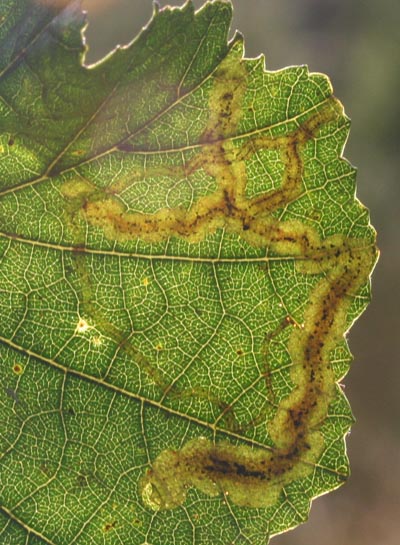
I was working a line of Alders tonight and found this mine:

Mine of the Agromyzid fly Agromyza alnivora on Alder
Agromyza alnivora is a rarely-recorded fly with a wide distribution range, and I have only found it twice. Alder is a very common tree, so there must be some reason for its scarcity. I notice that the mine is very long and tortuous, starting near centre-right and wandering roughly clockwise twice before descending down the right-hand side to the crescent-shaped exit point (bottom centre).  This is a very much longer mine than I would expect to see from a miner of this size, so I can only assume that it is a very inefficient feeder (Alder is clearly a very nutritious plant, given the number of species that feed on it). This, in turn, will increase opportunities for competing organisms to dominate and for parasites/predators to attack. If I had to hazard a guess, I would say that this is a species that is relatively new, or is on the way out.

The Peacock butterfly relies on Nettles for larval food, so I'm always a bit puzzled that I see most of my local specimens in an area where there are no nettles (that I know of) for hundreds of metres in any direction.

Peacock butterfly
This area is at the edge of recently-harvested coniferous plantation, so perhaps there is some 'memory' of nettles in previous decades.

Moths to light include:

Large Yellow Underwing (a clear sign of the progressing year):

Large Yellow Underwing
Rosy Minor:
Rosy Minor

The extremely variable Common Marbled Carpet:

Common Marbled Carpet

And a new (to me) micromoth:

Epinotia nisella

Epinotia nisella is a Willow feeder. This specimen is not of the usually-illustrated form, but is more like the mainland European specimens.

New to my Species Index.


Tuesday, 23 August 2011

What's that yellow thing in the sky?

Sun! We had almost four hours of continuous sun today, so I made a bee-line for the Angelica.

I took around 200 shots of whatever looked good, and these are the highlights:

The Peacock is a butterfly that I see quite rarely. I'm not sure if there were a few of them on this woodland ride today, or if the same one was flying along overtaking me from time to time. The Peacock is a nettle feeder and the late summer generation is emerging now. These will overwinter as adults, emerging in spring as soon as it's warm enough:
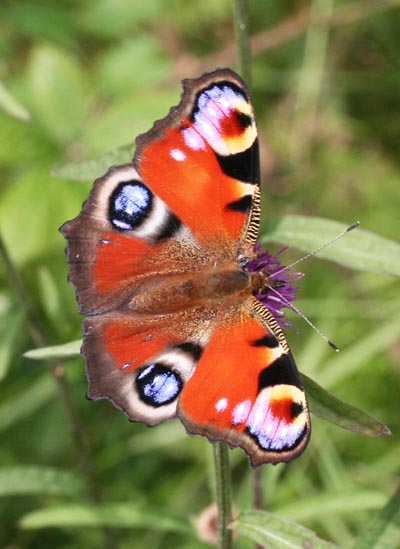
Peacock butterfly

Sicus ferrugineus is a conopid fly that can often be found crouched on knapweed flowerheads waiting for a bumblebee to land:

The Conopid fly Sicus ferrugineus
These are parasitic on worker bumblebees, but although I saw a good number of Bombus pascuorum workers today, none of them landed near the fly.

Leucozona glaucia is one of the most colourful hoverflies that we have. The combination of blue abdomen, yellow scutellum and shiny brown thorax is quite striking.

The hoverfly Leucozona glaucia
I caught a few glimpses of its duller relative, Leucozona laternaria, which I hope to show soon.

Sawfly larvae can be distinguished from moth and butterfly larvae by counting the number of prolegs. But I can generally pick them out quite quickly by their very round-shouldered appearance:

Sawfly larva on Ribwort Plantain
This close-up shows the semi-translucent nature of the body:
Close-up of sawfly larva
I went through the checklist of sawfly larvae and their host plants, but the only one specific to Ribwort Plantain doesn't match. That probably makes it a generalist polyphage, so the only way to find out what species it is would be to breed it through and identify the adult.

Caddis Flies are often mistaken for moths, especially when they come to light at night. The main distinguishing feature is the forward-facing antennae (although some of the longhorn moths also have this feature, in which case the Caddis Flies are recognised by their almost parallel antennae). This specimen is a female, identified by the greater number of jointed segments (5) in her mouthparts:

Caddisfly, member of the Limnephilidae family
That's the first Caddis that I've seen nectaring.

Caddis larvae are aquatic, living inside a case made from stones, shells, twigs or leaves, so the adults are usually seen close to water.

The Great Diving Beetle is also aquatic, and I found this one lying dead near a dried-out puddle:

Great Diving Beetle

The Angelica is already running to seed, so I suppose I might have another two weeks of it left. It's certainly a major source of nectar for insects, and I found hundreds of hoverflies, dungflies, sawflies and other assorted insects nectaring on it today. This ichneumonid caught my eye, due to its very long ovipositor:

Ichneumonid on Angelica


Monday, 1 September 2008

Another mixture

Waxcaps tend to be amongst the brightest of our fungi. This is the Blackening Waxcap - Hygrocybe nigricans. They vary from yellow to orange to red, but will always end up jet black.


The autumn generation of the Peacock butterfly has just emerged. These will overwinter as adults, and their offspring will emerge next autumn.


I put out a Heath trap the other night (thanks, Peter) and found a few interesting moths mixed in with plenty of Large Yellow Underwings. This is the Pink-barred Sallow - Xanthia togata, which feeds on Willows.
Moth traps usually attract Caddis Flies and Beetles, but I also found this Ichneumonid with extraordinarily long antennae. I guess it's a male.