Showing posts with label Large Red Damselfly. Show all posts

Wednesday, 4 May 2011

Four wings good?

I usually associate the first damselflies of the year with fern fronds, because they use them as perches to sun themselves and as launching pads for a leap to catch their prey. This year, however, the ferns are still unfurling and the damsels are having to resort to Bramble for resting on. This is a female Large Red Damselfly:

Female Large Red Damselfly

The standard definition of Diptera, or flies, is that they have only two wings. This is true, but only to a certain extent. Flies do indeed have only two wings in the conventional sense, but they also have two modified wings: the halteres. This shot shows the two halteres - located just behind the large, main wings - of a Cranefly:

Halteres of Cranefly
The halteres vibrate at roughly 45 degrees from the axis of the fly, but at 90 degrees to each other. Due to the coriolis effect, they act as gyroscopes and transmit information about rotation to help the fly to stabilise during manoeuvres. Bees, wasps, butterflies, moths, dragonflies and many other insects have 4 wings, but flies generally have more manoeuvering and hovering capability due to their combination of two wings with two halteres.

When I'm looking for moths at night, I often find other insects attracted to the light. This Cockchafer was hanging on my wall last night:

Cockchafer beetle
The Cockchafer has a very interesting lifecycle: the larvae live underground for three or four years, and the adults tend to be seen more frequently in three or four year cycles. There appears to be another cycle of perhaps 30 years, when the beetles are seen in huge numbers. The specimen in the picture above appears to have lost its right antenna.

The micromoth in the next shot has a glorious name: Schreckensteinia festaliella. 


This moth always lands with its middle legs outstretched and pointing upwards. I suppose with all those spikes, it must be the only safe place to put them.

As I have mentioned before (and will doubtless mention again), Pug moths are rather difficult to identify to species. The Foxglove Pug can be separated from the very similar Toadflax Pug by the 'notch' in the outer edge of the dark bar, as indicated by the arrow: 
Foxglove Pug, showing notch in wing bar
Size and timings are also different between the two species, but without a comparison, and given the very early season we're having, we have to act on the clues we are left with.


Saturday, 29 May 2010

Everything's happening

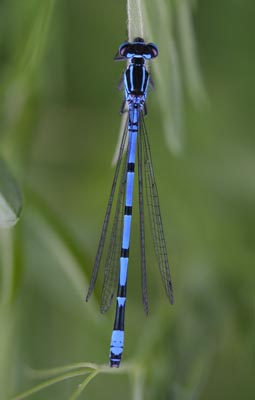
A few more damselflies today; first a male Azure Damselfly:

And a female Large Red:
Hawthorn blossom, or 'May':

The seeds of Cow Parsley are already forming. These look like beetles complete with antennae. When they eventually turn black, the resemblance is even more convincing.

The next major flower to appear on the hedgerow is Meadow Vetchling, or Meadow Pea. The emerging shoots are very distinctive with their flattened appearance:
A couple of days ago I showed some Lady's Smock - Cardamine pratensis - with four Orange Tip eggs. This is the same plant with a roosting male. The attraction of the plant to the butterfly is extremely strong: most of the roosting specimens I find are on Cardamine.

Monday, 10 May 2010

Sudden bounty

We've had a few wet and dull days and then sudden sun and heat. On today's walk I found perhaps a dozen Large Red Damselflies, many of them very recently hatched.

This is a male:


And this, a female:

When damselflies hatch, they have only an overall pale pink pigmentation (they're called 'teneral' at this stage), but the colour soon develops. This female is taking colour from the top down:

A couple of new hoverflies for this year:

Helophilus pendulus:


And Rhingia campestris:

I always wondered why Rhingia campestris has that very pronounced 'snout', but over the years I have taken enough close-ups to find that it has an extremely long tongue which is folded back and forth inside it. That enables it to reach nectar in flowers that other insects can't reach.

This is an Ichneumonid that I frequently see in summer. It's quite large - about 20mm long, excluding antennae - which means it must target one of the larger moth larvae as a host. Something like the Drinker would be about the right size.

Love that shadow.

Tuesday, 2 June 2009

Quarry visit

The local disused quarry is excellent for wildlife. It's a suntrap and the bottom level is flooded, which is good for Damselflies and Dragonflies. I also find a few plants here that I don't find locally elsewhere.

Damselflies are pink on emergence, but quickly change to their proper colour. This male Common Blue Damselfly is just showing tiny hints of blue: Enallagma cyathigerum.


And here are two females:


Last week I showed the male Large Red Damselfly. This is the female:


Heath Speedwell is one of my favourites, with its large, mauve flowers.


Mouse-ear Hawkweed is quite distinctive. This is the only place I find it locally.

Friday, 22 May 2009

More colour (well, red)

I had a hunch that it was time for Damselflies and, sure enough, I found a single male of the Large Red Damselfly - Pyrrhosoma nymphula. Wonderful colour.


It allowed me to take many close shots, so I assumed it had freshly emerged.


The Blues won't be far behind.

I didn't even look at the fern, but it looks to be Scaly (Golden) Male Fern.